
Public Lectures
Canadian Mennonite University presents a number of annual lecture events, including:
- J.J. Thiessen Lecture Series | October 20–21, 2026
- John and Margaret Friesen Lectures
- CSOP Lecture Series
Other past lectures
- Scientist in Residence Lecture Series
- Rev'd Dr. David Widdicombe – And His Hands Prepared the Dry Land
- Rev'd Dr. David Widdicombe Lecture – To Sow the Wind
- Winter Lecture Series
- Proclaiming the Claims of Christ Lecture Series

The J.J. Thiessen Lecture Series
Founded in 1978 by Canadian Mennonite Bible College, the J.J. Thiessen Lectures are named in honour of a founder and long-time chairperson of the CMBC Board. The lectures seek to bring to the Canadian Mennonite University community something of his breadth of vision for the church.
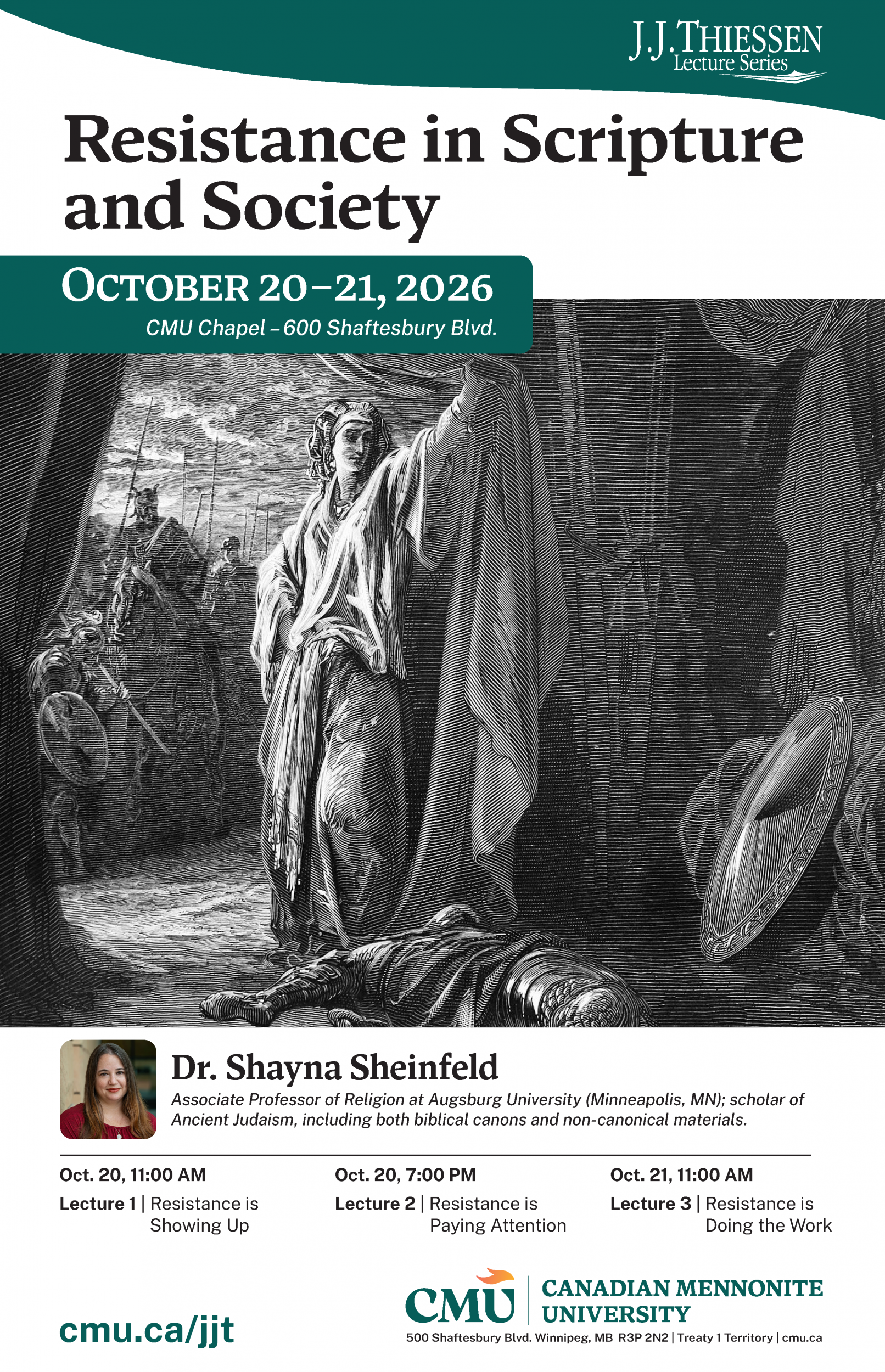
Resistance in Scripture and Society
with Dr. Shayna Sheinfeld
[ news release ]
October 20–21, 2026
As modern political anxieties grow over the rise of authoritarian tendencies and democratic strain in North America and across the globe, dissent feels more urgent than ever. What resistance looks like, however, varies with individuals, communities, and movements. In this lecture series, we will explore how acts of resistance show up in the Bible and beyond by examining how women and other minoritized populations challenged their oppression. Analyzed through the lenses of showing up, paying attention, and doing the work, these ancient figures offer powerful models for disruptive and subversive action for audiences today.
About Dr. Sheinfeld
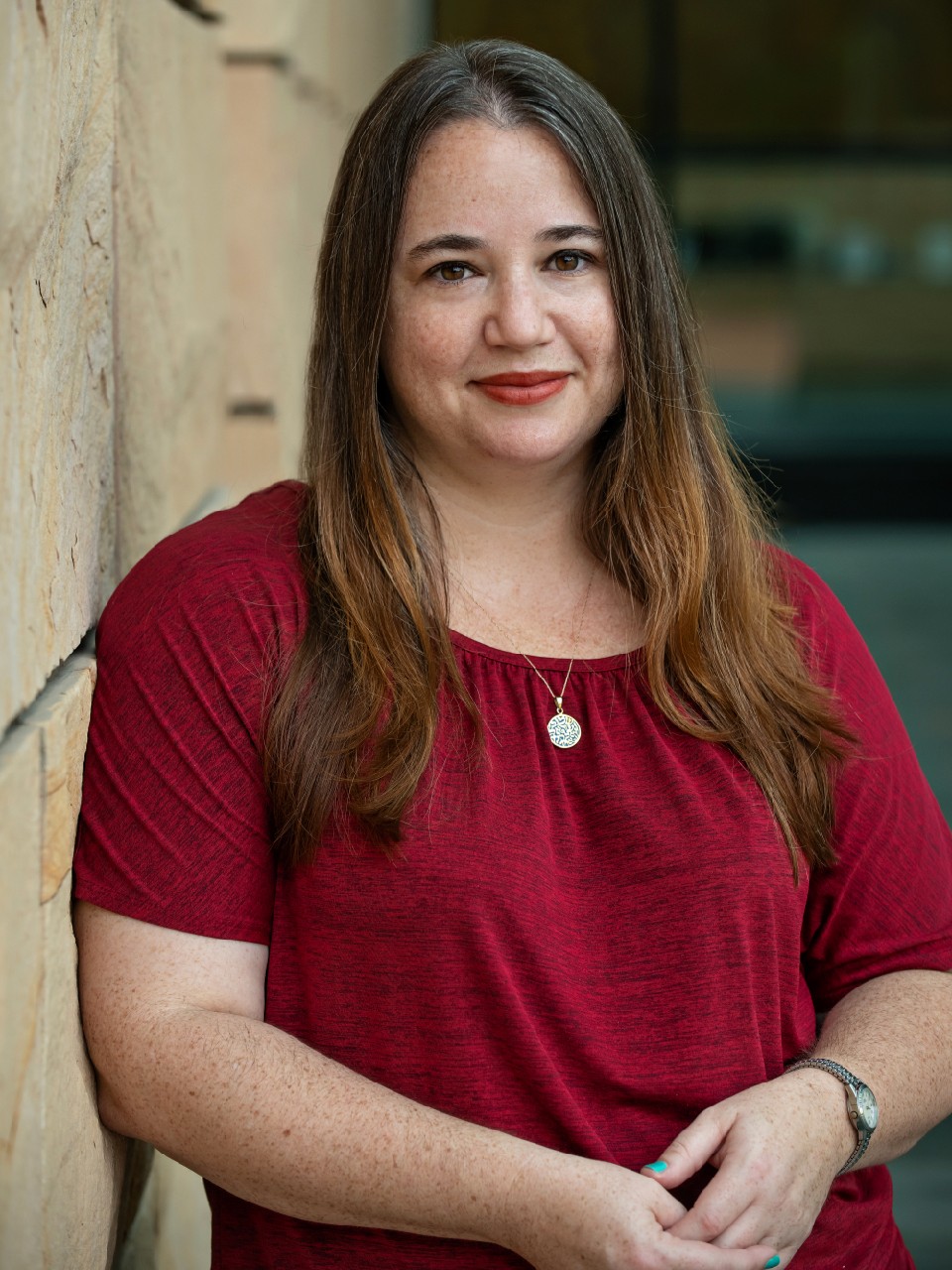
Dr. Shayna Sheinfeld (PhD, McGill University) is Associate Professor of Religion at Augsburg University (Minneapolis, Minnesota, USA). Sheinfeld is a scholar of Ancient Judaism, including both biblical canons and non-canonical materials. Her work emphasizes the vast diversity of Judaism in the ancient world. Sheinfeld has published extensively on Bible, apocalypse, popular culture, and gender, and is the author and editor of multiple books, including Jewish and Christian Women in the Ancient Mediterranean (with Sara Parks and Meredith Warren), which won the Canadian Society of Biblical Studies Frank W. Beare Award for Outstanding Book (2023) and the British and Irish Association for Jewish Studies, Honourable Mention for Best Book (2024).
All lectures are free; all are welcome.
All lectures will take place in the CMU Chapel, 600 Shaftesbury Blvd.
Recordings of these lectures will be posted here when available.
Lecture 1 | Resistance is Showing Up
Tuesday, October 20 at 11:00 AM
Examining the biblical figure of Esther, among others, this lecture will explore how the act of showing up—physical and rhetorical presence—can disrupt structures of power found in the text, and how showing up can be a way to resist today.
Lecture 2 | Resistance is Paying Attention
Tuesday, October 20 at 7:00 PM
Using the narrative of Jael (Judges 4–5) and stories of the Zealots in Josephus, this lecture will examine how we as readers of ancient text bring our own assumptions to ancient narratives—and how by paying attention to text and context, we can identify and deconstruct our own internalized systems of oppression.
Lecture 3 | Resistance is Doing the Work
Wednesday, October 21 at 11:00 AM
In this last lecture we will explore biblical models for doing the work of resistance, examining, among others, the apocryphal story of Judith and women followers of Jesus. Through this analysis we will explore the myriad ways that praxis can appear and consider the kinds of work we ourselves might do in the current environment.
Previous J.J. Thiessen Lectures
Past annual J.J. Thiessen Lectures published by CMU Press.
2025: Dr. Kevin Hector, Naomi Shenstone Donnelley Professor of Theology and of the Philosophy of Religions at the University of Chicago
Topic: A Sacred Way of Life: Theology as a Guide to Spirituality
2024: Dr. Bruce Hindmarsh, James M. Houston Professor of Spiritual Theology and Professor of the History of Christianity at Regent College, Vancouver, BC
Topic: "True Religion" in a Modern World: The Spiritual Theology of the Early Evangelicals
2023: Dr. Willie James Jennings, Associate Professor of Systematic Theology and Africana Studies, Yale Divinity School
Topic: Gathering the pieces that remain: Weaving life together from the fragments of faith, race, and land
VIDEO
2022: Dr. Robin W. Jensen, Patrick O'Brien Professor of Theology, University of Notre Dame
Topic: Picturing the Bible: How Artists Tell the Story
VIDEOS
2021: Dr. Edith M. Humphrey, William F. Orr Professor Emerita of New Testament at Pittsburgh Theological Seminary in Pittsburgh, PA
Topic: Mediation and the Immediate God
VIDEOS
2019: Dr. Nancy Elizabeth Bedford, Georgia Harkness Professor of Theology at Garrett-Evangelical Theological Seminary in Evanston, IL
Topic: Christology Revisited: Why Jesus Matters
VIDEOS
2018: Dr. John Witvliet, Director & Professor of Worship, Theology, and Congregational and Ministry Studies at the Calvin Institute of Christian Worship in Grand Rapids, MI
Topic: Violence, Injustice, Trauma, and the Ordinary Practices of Christian Worship in a Social Media Age
VIDEOS
2017: Dr. C. Arnold Snyder, Professor Emeritus of History, University of Waterloo
Topic: Faith and Toleration: A Reformation Debate Revisited
VIDEOS
2016: Dr. J. Richard Middleton, Professor of Biblical Worldview and Exegesis, Northeastern Seminary in Rochester, NY
Topic: The Silence of Abraham, The Passion of Job: Explorations in the Theology of Lament
VIDEOS
2015: Dr. Darren Dochuk, Associate Professor in the Department of History at the University of Notre Dame
Topic: Crude Awakenings: The Faith, Politics, and Crises of Oil in America's Century?
VIDEOS
2014: Dr. John Swinton, Professor and Chair in Divinity and Religious Studies, University of Aberdeen, Scotland
Topic: Becoming Friends of Time: Disability, Timefulness and Gentle Discipleship
VIDEOS
2013: Dr. P. Travis Kroeker, Professor of Religious Studies, McMaster University
Topic: Mennonites and Mammon: Economies of Desire in a Post-Christian World
AUDIO Book
2012: Dr. Beverly Roberts Gaventa, Helen H. P. Manson Professor of New Testament Literature and Exegesis, Princeton Theological Seminary
Topic: From Powerlessness to Praise in Paul's Letter to the Romans
2011: Dr. Peter Widdicombe, McMaster University
Topic: Scripture and the Christian Imagination: Text, Doctrine, and Artistic Representation in the Early Church and Beyond
2010: Dr. Belden Lane, Saint Louis University
Topic: From Desert Christians to Mountain Refugees: Fierce Landscapes and Counter-Cultural Spirituality
AUDIO BOOK
2009: Dr. Peter Ochs, Edgar Bronfman Professor of Modern Judaic Studies, University of Virginia
Topic: The Free Church and Israel's Covenant
2008: Dr. Mark Noll, Professor of History, University of Notre Dame
Topic: A Yankee Looks North: Toward an Appreciation and Assessment of the History of Christianity in Canada.
2007: Dr. Ellen Davis, Professor of Bible and Practical Theology, Duke Divinity School
Topic: Live Long on the Land: Food and Farming from a Biblical Perspective.
2006: Dr. Joel J. Shuman, King's College, Wilkes-Barre, PA
Topic: To Live is to Worship: Bioethics and the Body of Christ
BOOK
2005: Dr. Paul J. Griffiths, Schmitt Professor of Catholic Studies at University of Illinois at Chicago
Topic: The Vice of Curiosity: Towards a Theology of Intellectual Appetite
BOOK
2004: Dr. Peter C. Erb, Professor of Religion & Culture at Wilfrid Laurier University, Waterloo, Ontario
Topic: Late Medieval Spirituality and the Sources for Peace and Reconciliation: Bridget of Sweden, Catherine of Siena, Julian of Norwich
2003: Dr. Paul G. Hiebert, Distinguished Professor of Mission and Anthropology at Trinity Evangelical Divinity School
Topic: Doing Missional Theology
2002: Dr. Seán Freyne, Professor of Theology in the School of Religions and Theology at Trinity College, Dublin
Topic: Jesus, Jews, and Galilee
2001: Dr. Letty M. Russell, Yale University Divinity School
Topic: Practising God's Hospitality in a World of Difference
2000: Dr. William P. Brown, William Marcellus McPheeters Professor of Old Testament, Columbia Theological Seminary
Topic: God and the Imagination: A Primer to Reading the Psalms in an Age of Pluralism
BOOK
1999: Dr. T.D. Regehr, Professor of History, University of Saskatchewan
Topic: Peace, Order & Good Government: Mennonites & Politics in Canada
BOOK
1998: Dr. Eugene H. Peterson, Professor of Spiritual Theology, Regent College
Topic: Christ Plays In Ten Thousand Places
1997: Dr. Richard B. Hayes, George Washington Ivey Professor of New Testament, Duke Divinity School
Topic: New Testament Ethics: The Story Retold
BOOK
1993: Dr. Phyllis A. Bird, Garrett-Evangelical Theological Seminary
Topic: Feminism and the Bible
1990: Dr. Werner O. Packull, Mennonite Archives of Ontario, Conrad Grebel University College
Topic: Rereading Anabaptist Beginnings

John and Margaret Friesen Lectures
The John and Margaret Friesen Lectures in Anabaptist/Mennonite Studies are co-sponsored by Canadian Mennonite University, the Mennonite Heritage Centre, and the Centre for Mennonite Brethren Studies. The inaugural lectures in November 2002 were delivered by Dr. Abraham Friesen (Professor of History, University of California, Santa Barbara), the generous donor who initiated the lecture series.
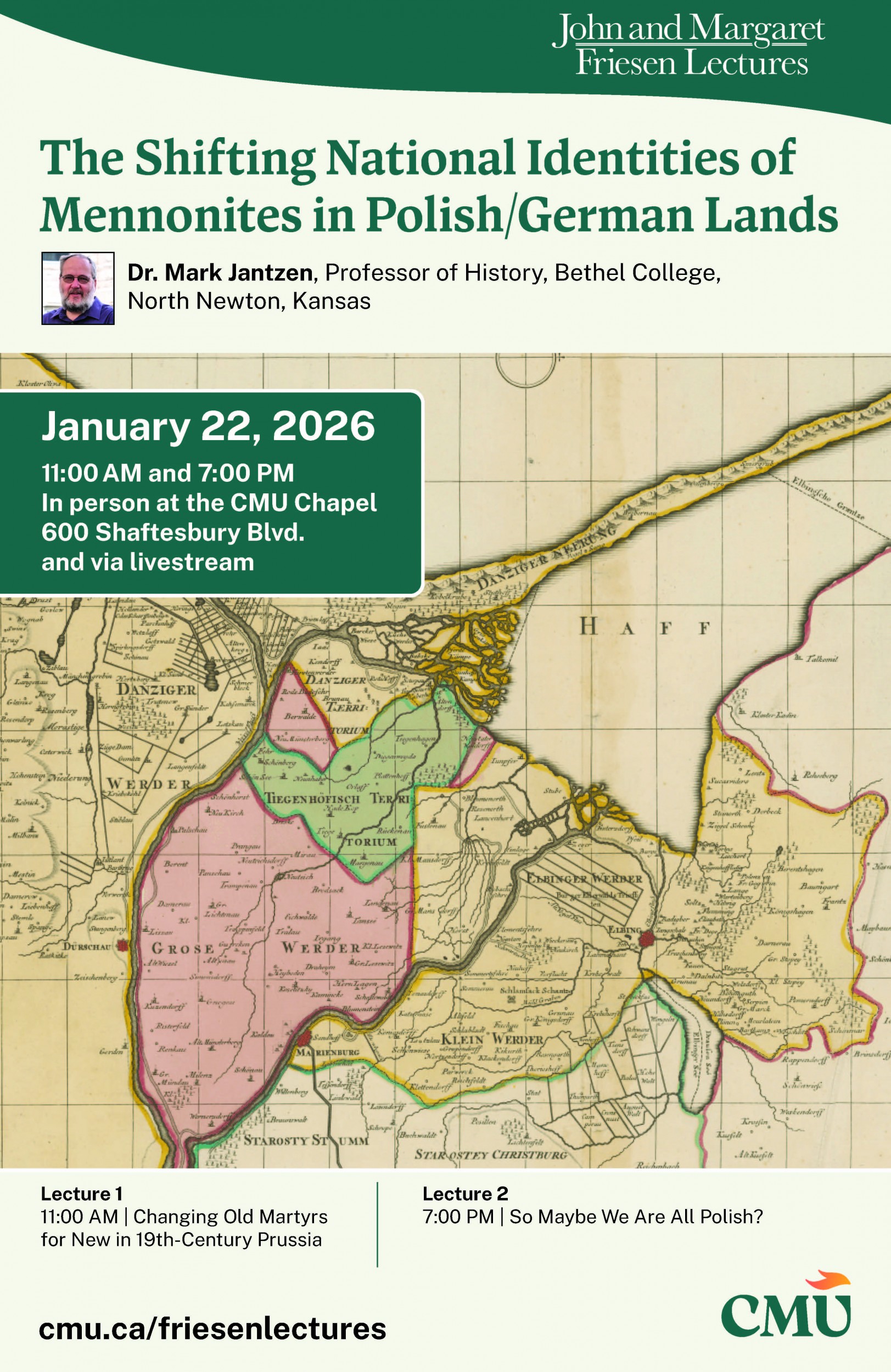
The Shifting National Identities of Mennonites in Polish/German Lands
with Dr. Mark Jantzen, Professor of History, Bethel College, North Newton, Kansas
January 22, 2026
- 11:00 AM | CMU Chapel (600 Shaftesbury Blvd.)
- 7:00 PM | CMU Chapel
- Both lectures will be livestreamed and available for on-demand viewing later
Dr. Mark Jantzen is a native of Nebraska and a Bethel College graduate who has lived and worked extensively in Europe. From 1988-91, he studied theology at Humboldt University in East Berlin as part of the Mennonite Central Committee (MCC) East Europe Study/Service Program, and from 1993-96, he worked at resource development for Bread of Life in Belgrade, Serbia, and as regional coordinator for MCC.
He is author of Mennonite German Soldiers: Nation, Religion and Family in the Prussian East, 1772-1880 (University of Notre Dame Press, 2010) and The Wrong Side of the Wall: An American in East Berlin during the Peaceful Revolution (1993).
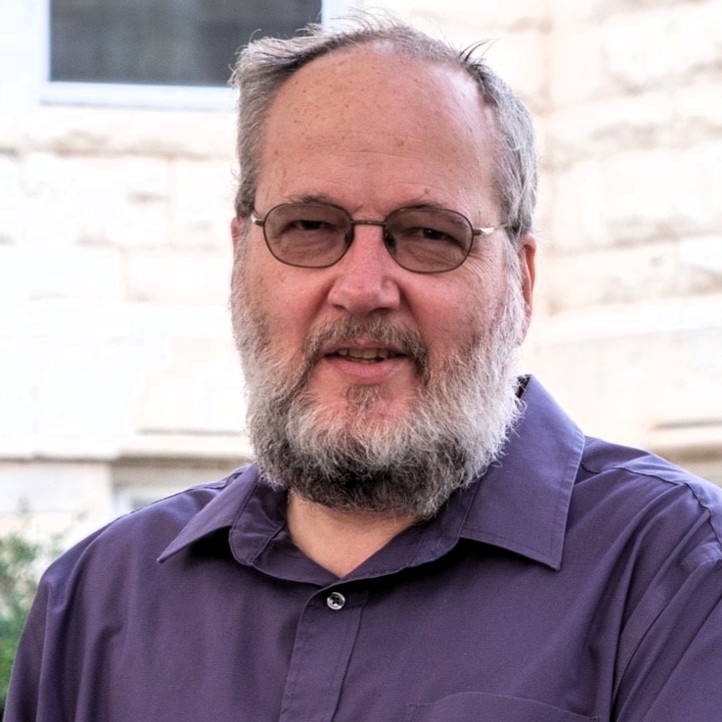
He was a contributing editor for Volume 5 of Mennonitisches Lexikon (2020). With John D. Thiesen, he is co-editor of two translations, The Military Service Exemption of the Mennonites of Provincial Prussia by Wilhelm Mannhardt (Bethel College, 2013) and The Danzig Mennonite Church: Its Origin and History from 1569-1919 by H.G. Mannhardt (Pandora Press, 2007), and two volumes of collected research, European Mennonites and the Challenge of Modernity over Five Centuries: Contributors, Detractors, and Adapters (Bethel College, 2016) and European Mennonites and the Holocaust (University of Toronto Press in association with the United States Holocaust Memorial Museum, 2020). He is also co-director of the Mennonite Polish Studies Association.
Lecture 1 | Changing Old Martyrs for New in 19th-Century Prussia
11:00 AM | CMU Chapel (600 Shaftesbury Blvd.)
In the 1780s, under the stress of switching from life under Polish rule to new Prussian rulers during the Partitions of Poland, Mennonites in the Vistula Delta published a slim volume of martyrs’ stories in anticipation of new hardships and to renew their spiritual commitments to oath avoidance, non-resistance, and adult baptism. By the second half of the 1800s, however, many stopped referring to these old stories and found instead new sources of inspiration in the stories of more modern national heroes and martyrs, giving rise to conflicting martyr narratives in the same Mennonite community.
Lecture 2 | So Maybe We Are All Polish?
7:00 PM | CMU Chapel (600 Shaftesbury Blvd.)
The Mennonites of the Vistula Delta were subjects of the Polish king for over two centuries, serving until 1793 as one small patch on the multi-lingual, multi-faith, multi-ethnic tapestry that was the Polish Lithuanian Commonwealth. The majority who ended up first under the Prussian kings and then the German Emperors and did not emigrate adopted a German national identity while remaining on lands Polish nationalists still considered Polish. Identifying and identified as Germans, all but a handful fled or were expelled at the end of World War II, leaving behind an architectural and cultural legacy. With the demise of Communism and the passage of time, local Poles, many whose grandparents arrived as refugees from the east taking over former Mennonite houses and churches, are now celebrating the presence of Mennonite culture in Poland in order once again to highlight Polish religious diversity.
Previous John and Margaret Friesen Lectures
2025: Anabaptist Peace Witness – Historical Significance and Today's Mission
Lecturer: Dr. Astrid von Schlachta, Head of the Mennonite Research Center and lecturer at the University of Regensburg
2024: Revisiting the Mennonite Experience in Ukraine
Lecturer: Dr. Nataliya Venger, Professor of History and Chair of the World History Department at Dnipropetrovsk National University, Ukraine
2023: The Neglected Role of Dutch Mennonite Innovators in the Scientific Revolution and Early Enlightenment
Lecturer: Dr. Gary K. Waite, Professor Emeritus, Dept. of History, University of New Brunswick
2022: Reading Mennonite Writing Now
Lecturer: Dr. Robert Zacharias, Associate Professor of English, York University
2020: What if Mennonites Had Never Left the Netherlands? – CANCELLED
Lecturer: Dr. Piet Visser, Professor Emeritus of Vrije Universiteit, Amsterdam
2019: A Twentieth Century Reformation: Anabaptism in Guatemala
Lecturer: Dr. Patricia Harms, Associate Professor of History, Brandon University
2017: Faith and Toleration: A Reformation Debate Revisited
Lecturer: C. Arnold Snyder, Professor Emeritus, History, at Conrad Grebel University College
2015: Come Watch This Spider: Animals, Mennonites, and the Modern World
Lecturer: Royden Loewen, Chair in Mennonite Studies and Professor of History at the University of Winnipeg
2009: Mennonite Women in Canadian History: Birth, Food, and War
Lecturer: Marlene Epp of Conrad Grebel University College.
2008: Church and ethnicity: The Mennonite Experience in Paraguay
Lecturer: Alfred Neufeld, Dean of the School of Theology of the Protestant University of Paraguay.
2007: Mennonite Identity in the 21st Century
Lecturer: John D. Roth
2006: Sacred Spaces, Sacred Places: Mennonite Architecture in Russia and Canada
Presenters: Rudy Friesen, Harold Funk, Roland Sawatsky
2005: Recovering A Heritage: The Mennonite Experience in Poland and Prussia
Lecturer: Peter Klassen, Professor Emeritus of History, California State University, Fresno
2004: Mennonite and Brethren in Christ Church in Africa
Lecturer: Barbara Nkala, Director of the International Bible Society of Zimbabwe and Malawi
2002: Russian Mennonites and World War One
Lecturer: Dr. Abraham Friesen, Professor Emeritus of History, University of California
CSOP Lecture Series
"Going Local with International Crises: The Storytelling Dilemma"
with Monika Maria Kalcsics, a journalist with more than 20 years of experience in public service media, print, TV, and film as a reporter, producer, and commissioning editor of award-winning documentaries and reports
CANCELLED
Unfortunately, this event has been canceled due to external factors beyond our control. We apologize for the inconvenience.
How do international non-governmental organizations tell their stories when the pressure from news outlets is increasingly to create a hyper local connection?
- 30-minute presentation with Monika Maria Kalcsics
- 10-minute response from Susan Tymofichuk – Managing Editor, CTV News Winnipeg
- 30-minute Q&A with audience
About Monika Maria Kalcsics
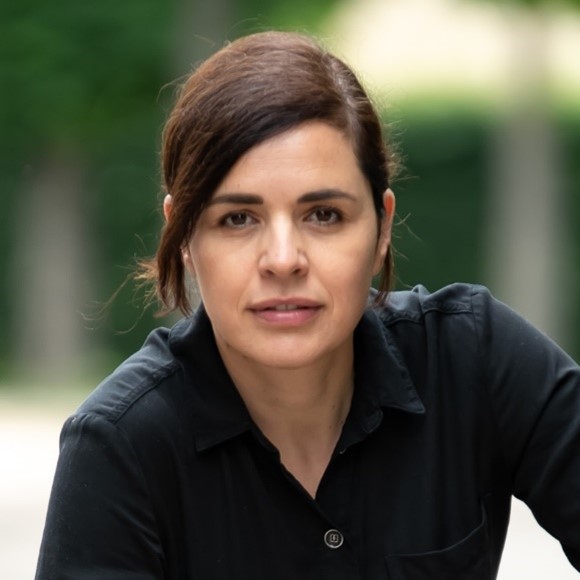
Currently employed by the science, education, and society department at Austria 1, the national information radio channel of ORF (Austrian Public Broadcasting Corporation), Kalcsics is also the head of the multimedia initiative "Fixing the Future – Casting New Ideas." She is also a founding member of the production company name>it positive media, covering underrepresented areas in the media. Across this time, she also made emergency aid missions, establishing communication lines.
Kalcsics' combined career as a journalist and emergency aid worker has allowed her to understand the challenges we face when confronted with a humanitarian disaster and the need to report it. She was granted a fellowship at the Reuters Institute for the Study of Journalism at Oxford University to research the relationship between aid organizations and the media in a "competitive compassion market".
Previous CSOP Lectures
2022: Choosing Love in the Wake of Wounding
Lecturer: Dr. Johonna McCants-Turner
Associate Professor of Peace and Conflict Studies, Conrad Grebel University College at the University of Waterloo
2020: The Myth of Religious Violence
Lecturer: Dr. William Cavanaugh, Professor of Catholic Studies, DePaul University
2019: Imagination, Courage, and Resilience
Lecturer: Dr. Emily Welty, professor and director of Peace and Justice Studies at Pace University, NY
2018: A Transformative Spirituality for Peacebuilding
Lecturer: Dr. Fernando Enns, Professor of Theology and Ethics at Vrije Universiteit (Free University), Amsterdam
2018: The TRC, Calls to Action and the Mountain Before Us: Stories of Hope and Challenge
Lecturer: The Honorable Senator Murray Sinclair
2016: Living with Uncertainty: The Road to Peace
Lecturer: John Ralston Saul, award winning essayist and novelist
Scientist in Residence Lecture Series
2024 CMU Scientist in Residence | Dr. Allyson Menzies
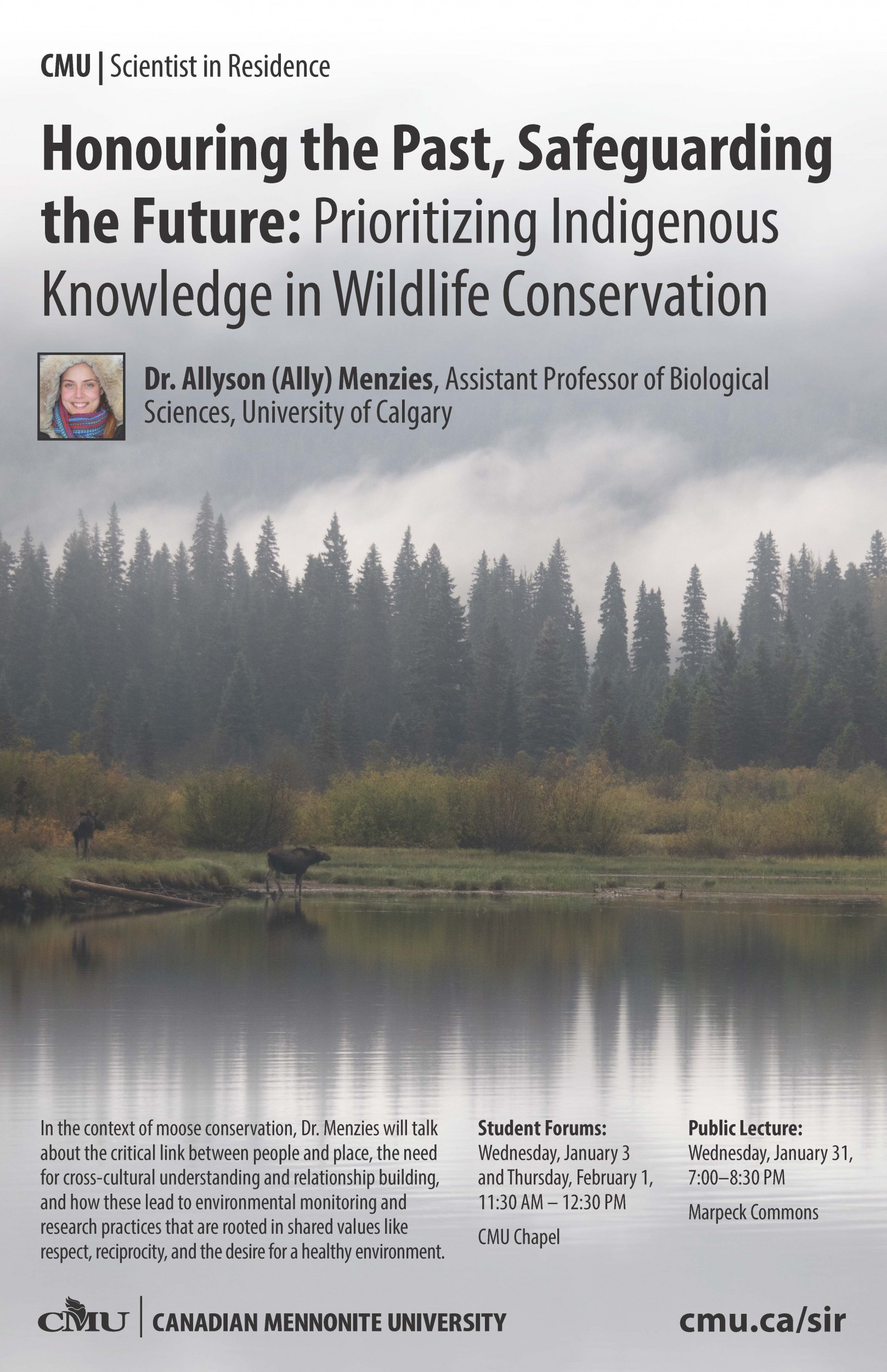
Assistant Professor of Biological Sciences, University of Calgary
Honouring the Past, Safeguarding the Future: Prioritizing Indigenous Knowledge in Wildlife Conservation
In response to widespread concerns related to declining moose populations in Manitoba and Ontario, Dr. Allyson Menzies participated as part of a research team that developed a number of Indigenous-led moose monitoring programs. This initiative—in partnership between Indigenous and non-Indigenous environmental professionals—gathered information on moose in a way that weaves Indigenous Knowledge and Western science in a respectful manner.
In her presentation, Menzies will:
- describe values and teachings that guide Indigenous relationships to the natural world, and how they can be applied to environmental research,
- provide tangible example of a community-led moose monitoring program that uplifts Indigenous Knowledge and values to document change in moose populations over time.
Throughout, Menzies will emphasize the critical link between people and place, the need for cross-cultural understanding and relationship building, and how both of these lead to environmental practices that rooted in shared values like respect, reciprocity, and the desire for a healthy environment.
About Dr. Allyson Menzies
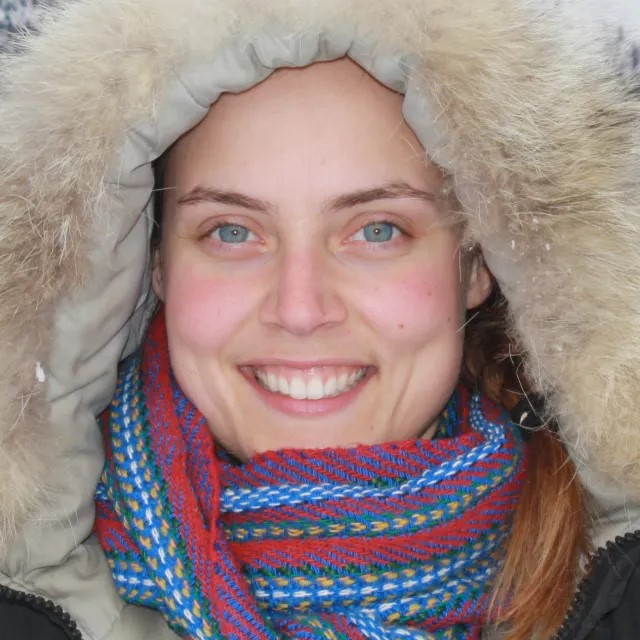
Dr. Allyson (Ally) Menzies is of mixed Red River Métis and Settler descent, from across Treaty 1 and 2 territory and the homeland of the Métis Nation. She studied hibernation physiology of cave-dwelling bats for her MSc, and winter physiology and behaviour of red squirrels, snowshoe hares, and Canada lynx in the Yukon for her PhD. Menzies’s postdoctoral work aimed to identify the Indigenous values that need to be better prioritized in wildlife monitoring and research, and to determine which methodologies and approaches are most effective at doing so. She is starting as an Assistant Professor of Biological Sciences at the University of Calgary in March 2024, where she will continue to work on developing approaches to environmental research, monitoring, and management that truly respect Indigenous rights and knowledge systems to create a path forward for conservation science that is rooted in mutual respect, reciprocity, and reconciliation.
Read more about Dr. Menzies and her research
Student Forums
CMU Chapel (600 Shaftesbury Blvd.)
Wednesday, January 31
Dr. Menzies will narrate her journey from aspiring med student to a leader in integrating Indigenous Knowledge systems in wildlife conservation. This talk highlights personal growth and the value of authenticity in scientific careers. Bring your career path questions and be prepared to share your own stories.
Thursday, February 1
For this panel discussion Ally will be joined by her sister, lawyer, and CMU volleyball coach Jayme Menzies, as well as CMU student Katrina Lengsavath. They will reflect on the challenges and lessons learned in fostering diversity in higher education, law, and sport. Their stories offer insights and actionable steps for individuals and institutions to nurture truly inclusive environments.
Public Lecture
Wednesday, January 31
7:00–8:30 PM
Marpeck Commons (2299 Grant Ave.)
– watch the public lecture livestream here on January 31 –
2023 CMU Scientist in Residence | Dr. Francis Su
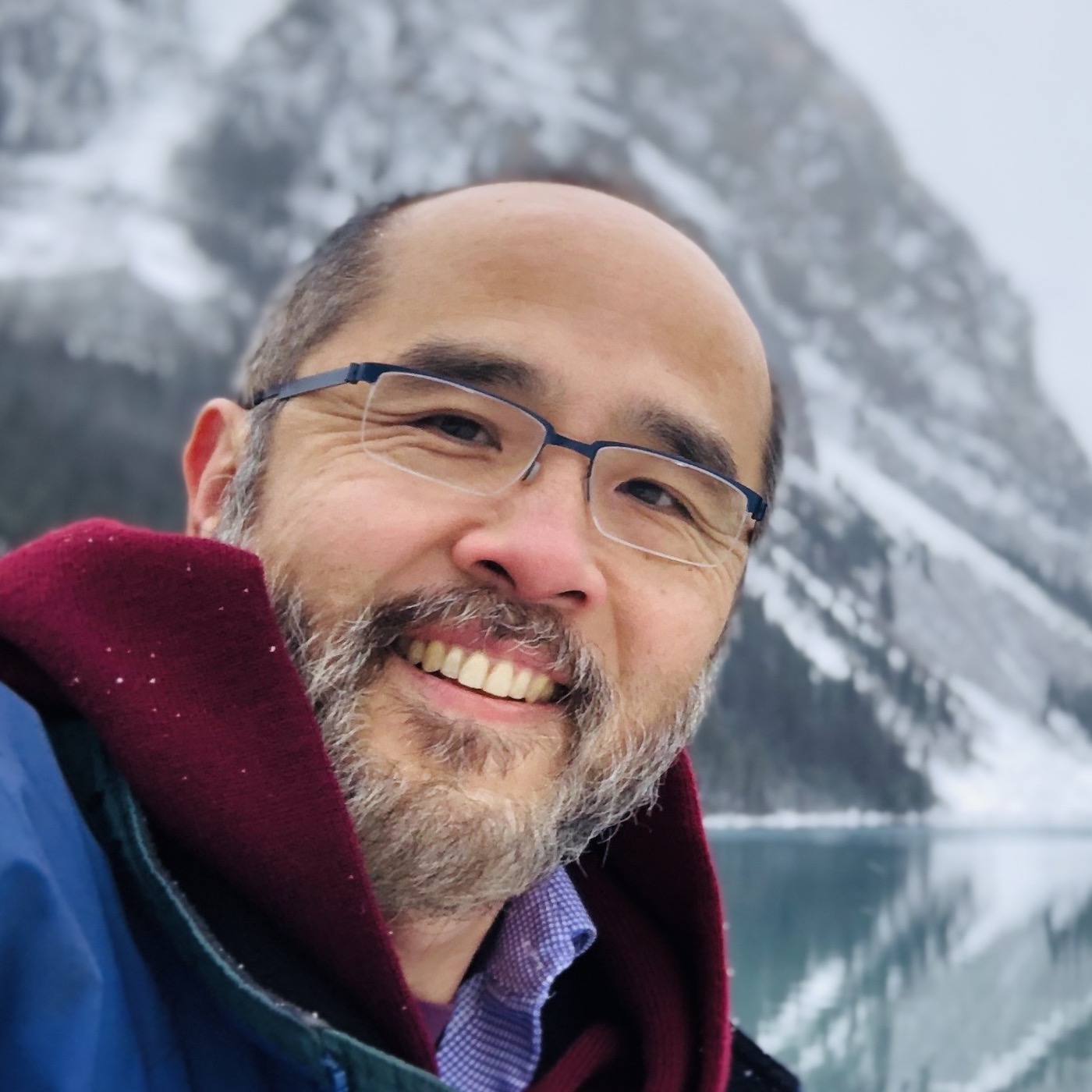
Dr. Francis Su is the Benediktsson-Karwa Professor of Mathematics at Harvey Mudd College and former president of the Mathematical Association of America. In 2013, he received the Haimo Award, a nationwide teaching prize for college math faculty, and in 2018 he won the Halmos-Ford writing award. His research in geometric combinatorics includes many papers co-authored with undergraduates.
Su's work has been featured in Quanta Magazine, Wired, and the New York Times. His book Mathematics for Human Flourishing (2020), winner of the 2021 Euler Book Prize, offers an inclusive vision of what math is, who it's for, and why anyone should learn it.
Equity, Diversity, and Inclusion in Mathematics and the Sciences: Challenges and Opportunities
Thursday, February 2 | Forum
11:30 AM, CMU Chapel (600 Shaftesbury Blvd.)
In 2020, I co-authored a report for the American Mathematical Society on the history of racial discrimination in the mathematical sciences. I'll share some of the lessons learned from this report, and discuss why equity diversity and inclusion is important to mathematics and the sciences, and what we can do to move towards making STEM spaces more just, where the dignity of each human being is valued.
Mathematics for Human Flourishing
Thursday, February 2 | Public Lecture
7:00 PM, Marpeck Commons (2299 Grant Ave.)
How can mathematics connect to our deepest human longings, such as for beauty, truth, or justice? This isn't the experience most have with math, but it can be. Math is a deeply human enterprise that when properly engaged, builds virtues like persistence, creativity, and an expectation of enchantment. Such virtues will serve you well no matter what you do in life. An incarcerated man—now my friend—has helped me see this more clearly than ever before.
Can Mathematics be Spiritual?
Chapel, Friday February 3 | Chapel
11:30 AM, CMU Chapel (600 Shaftesbury Blvd.)
A mathematical attitude of mind is surprisingly similar to a religious attitude of mind, and offers a bridge of understanding to those who aren't yet in either frame of mind.
2020 CMU Scientist in Residence | Dr. Deborah Haarsma

Dr. Deborah Haarsma is President of BioLogos. She is a frequent speaker on modern science and Christian faith at research universities, churches, and public venues like the National Press Club. Her work appears in several recent books, including Four Views on Creation, Evolution, and Design and Christ and the Created Order. She wrote the book Origins with her husband and fellow physicist, Loren Haarsma, presenting the agreements and disagreements among Christians regarding the history of life and the universe. She edited the anthology Delight in Creation: Scientists Share Their Work with the Church with Rev. Scott Hoezee. Previously, Haarsma served as professor and chair of the Department of Physics and Astronomy at Calvin College. She is an experienced research scientist, with several publications in the Astrophysical Journal and the Astronomical Journal on extragalactic astronomy and cosmology. She has studied large galaxies, galaxy clusters, the curvature of space, and the expansion of the universe using telescopes around the world and in orbit. Haarsma completed her doctoral work in astrophysics at the Massachusetts Institute of Technology and her undergraduate work in physics and music at Bethel University. She and Loren enjoy science fiction and classical music, and live in Grand Rapids, Michigan.
"The Universe Declares the Glory of God"
Monday, February 3 | Chapel
11:30 AM, CMU Chapel (600 Shaftesbury Blvd.)
Dr. Haarsma shares her scientific and spiritual journey. When viewed through the lens of biblical faith, the universe reveals God's beauty, faithfulness, and creativity.
"What Would Life Beyond Earth Mean for Christians?"
Wednesday, February 5 | Forum
11:30 AM, CMU Chapel (600 Shaftesbury Blvd.)
Astronomers have now discovered thousands of planets in orbit around other stars. We may soon be able to detect whether those planets contain living things. But will that life be intelligent? Will we be able to communicate with it? What would such discoveries mean for Christian theology?
"God and the Multiverse"
Wednesday, February 5 | Public Lecture
7:00 PM, Marpeck Commons (2299 Grant Ave.)
The last century has transformed our understanding of the cosmos. We now know that the universe began 13.8 billion years ago in a Big Bang and that it continues to expand at an ever-increasing rate. We marvel at the evidence of physical laws fine-tuned for life. New research hints that our universe may be part of a much bigger multiverse of imagination-staggering immensity. Dr. Haarsma will lead a fascinating tour of the cosmos and discuss the implications of recent discoveries for our understanding of scripture, of God, and of ourselves.
2019 CMU Scientist in Residence | Dr. Dennis R. Venema

Dr. Dennis R. Venema (PhD, University of British Columbia) is Professor of Biology at Trinity Western University (Langley, British Columbia, Canada). He is co-author, with theologian Scot McKnight, of Adam and the Genome: Reading Scripture after Genetic Science (Brazos, 2017).
From 2011 to 2018 Venema was Fellow of Biology for the BioLogos Foundation.
His research is focused on the genetics of pattern formation and signaling using the common fruit fly Drosophila melanogaster as a model organism.
Venema is a gifted thinker and writer on matters of science and faith, but also an award-winning biology teacher—he won the 2008 College Biology Teaching Award from the National Association of Biology Teachers.
Venema and his family enjoy numerous outdoor activities that the Canadian Pacific coast region has to offer. He writes and speaks frequently on evolution and Christian faith.
Monday, February 4 | Student Forum
11:30 AM, CMU Chapel (600 Shaftesbury Blvd.)
Adam, Eve, and Evolution: Navigating the Issues
Evangelicals are in the midst of a spirited debate about Adam and evolution. Do we share ancestry with other forms of life? Do all humans descend from a specially-created couple? How do Christians who accept evolutionary biology harmonize their faith with the findings of science?
Tuesday, February 5 | Chapel
11:30 AM, CMU Chapel (600 Shaftesbury Blvd.)
Loving God with our Hearts, Souls, and Minds
Christianity has a long history of studying creation as an act of worship, and the Christian conviction that nature is ordered by God was a significant factor in the development of modern science. As believers, how can we honour God in the present day as we explore His creation?
Wednesday, February 6 | Public Lecture
7:00 PM, Marpeck Commons (2299 Grant Ave.)
Fearfully and Wonderfully Made? Adam, Eve, and Evolution
Christians hold that God is the Creator, and that he brought the world and life into being as an intentional act of design. Modern genomics strongly supports the hypothesis that random mutation and natural selection are a key part of evolution, including for humans. Are these claims at odds with one another? Is it possible to view evolution as a form of design?
2018 CMU Scientist in Residence | Dr. Rick Lindroth
Rick Lindroth (PhD, University of Illinois-Urbana) is a Vilas Distinguished Achievement Professor of Ecology and recent Associate Dean for Research at the University of Wisconsin-Madison (USA). His research focuses on evolutionary ecology and global change ecology in forest ecosystems. He and his students have published ~200 peer-reviewed scientific articles and book chapters. Lindroth has been a Fulbright Fellow and is a Fellow of the Ecological Society of America, the Entomological Society of America, and the American Association for the Advancement of Science (AAAS).
Lindroth has served in numerous roles at his church, including many years on the governing board. He and his wife have two married daughters and two grandsons. For recreation, they enjoy road cycling, fly fishing, and reading—though not necessarily in that order.
Monday, January 29 | Student Forum
11:30 AM, CMU Chapel (600 Shaftesbury Blvd.)
Two Degrees of Separation: Climate Change and the Christian Challenge
Climate change is arguably the most important, and most polarizing, scientific issue of the 21st century. The "debate" is nonexistent in science, but heated within political and even religious circles. What does science know to be true about climate change, how serious is it, and how should Christians, as bearers of truth and stewards of the planet, respond?
Tuesday, January 30 | Chapel
11:30 AM, CMU Chapel (600 Shaftesbury Blvd.)
Life at the Intersection of Science and Faith: A Biologist's Story
The relationship of science to faith is widely perceived as one of conflict and incompatibility. Yet, as evidenced by Israelite King David and Psalm 19, the people of God have long recognized a rich complementarity between the study of God's book and God's creation. Lindroth will reflect on how, over a 30-year career, his perspectives and approaches toward science and faith have enriched and enhanced each other.
Tuesday, January 30 | Public Lecture
7:00 PM, Marpeck Commons (2299 Grant Ave.)
Science as a Way of Knowing: the Pursuit of Truth in a Post-Truth World
More than any other arena of human endeavour over the last century, science has revealed the true nature of how the world works, and has fostered technologies that have transformed civilization. Yet now, in a world of individual truths and alternative facts, the value of science is being challenged like never before. Here we will explore the fundamental premises of science, why they predispose science to dismissal and denial, how humans engage with facts, and how to improve science communication across ideological, cultural, and tribal divisions for the betterment of humanity and sake of the world.
2017 CMU Scientist in Residence | Dr. Katharine Hayhoe

Named to TIME magazine's 100 Most Influential People in the World list for 2014, Dr. Katharine Hayhoe is an atmospheric scientist who studies climate change, one of the most pressing issues facing humanity today. But Hayhoe may be best-known to many people because of how she's bridging the broad, deep gap between scientists and some Christians—work she does in part because she's a Christian herself.
Together with her husband Andrew Farley, a professor of applied linguistics, pastor of Church without Religion, and best-selling author, Hayhoe wrote A Climate for Change: Global Warming Facts for Faith-Based Decisions, a book that untangles the complex science and tackles many long-held misconceptions about global warming. Her work as a climate change evangelist has been featured on the Emmy award-winning documentary series "Years of Living Dangerously" and "The Secret Life of Scientists and Engineers."
Hayhoe is a professor at Texas Tech University, and the director of its Climate Science Center. She has a BSc in Physics from the University of Toronto and an MS and PhD in Atmospheric Science from the University of Illinois. Hayhoe is currently serving as lead author for the upcoming Fourth U.S. National Climate Assessment and producing her new PBS Digital Studios short series, Global Weirding: Climate, Politics and Religion (see the Global Weirding Facebook page for more on the series).
TEDx Talk Bill Moyers: Climate Change Faith and Fact AAAS: What We Know Dr. Hayhoe's YouTube channel CMU News Release Get to Know Dr. Hayhoe
January 30 | Student Forum
11:30 AM, CMU Chapel (600 Shaftesbury Blvd.)
Science in a Post-Truth World: A Climate Scientist's Perspective
In public discourse today, opinions often overwhelm facts. Both science and faith, however, are based on immutable truths. The reality of God doesn't depend on whether we believe in Him or not—and if we step off a cliff, we're going down, regardless of our opinion on gravity.
How can we be "salt and light" in a world that rejects the existence of unchanging truth? Join Dr. Hayhoe as she shares from her experiences from the field of climate science.
January 31 | Chapel
11:30 AM, CMU Chapel (600 Shaftesbury Blvd.)
Listening to God's Creation: A Faith Story
When we listen to God's creation, what is it telling us?
Join Dr. Hayhoe as she shares what we know about our planet today, and reflects on a Christian response to the responsibility we've been given to care for it.
Genesis 1:26-28
God spoke: "Let us make human beings in our image, make them reflecting our nature So they can be responsible for the fish in the sea, the birds in the air, the cattle, And, yes, Earth itself, and every animal that moves on the face of Earth." God created human beings; he created them godlike, Reflecting God's nature. He created them male and female. God blessed them: "Prosper! Reproduce! Fill Earth! Take charge! Be responsible for fish in the sea and birds in the air, for every living thing that moves on the face of Earth."
Galatians 5:13-14 and 22-23
It is absolutely clear that God has called you to a free life. Just make sure that you don't use this freedom as an excuse to do whatever you want to do and destroy your freedom. Rather, use your freedom to serve one another in love; that's how freedom grows. For everything we know about God's Word is summed up in a single sentence: Love others as you love yourself. That's an act of true freedom.
But what happens when we live God's way? He brings gifts into our lives, much the same way that fruit appears in an orchard—things like affection for others, exuberance about life, serenity. We develop a willingness to stick with things, a sense of compassion in the heart, and a conviction that a basic holiness permeates things and people. We find ourselves involved in loyal commitments, not needing to force our way in life, able to marshal and direct our energies wisely. Legalism is helpless in bringing this about; it only gets in the way.
February 1 | Public Lecture
7:00 PM, Marpeck Commons (2299 Grant Ave.)
Talking Climate: Why Facts are Not Enough
Is climate really changing? Are humans responsible, or is this just a natural cycle like we've seen before? And even if it is warming, who cares—wouldn't we all prefer a little less snow?
Join Dr. Hayhoe as she discusses the compelling science behind a changing climate, describes the innovative solutions that are already being implemented today, and explores the importance of connecting our hearts to our heads when it comes to caring about the impacts of a changing climate on this planet and the people who live on it.
2016 CMU Scientist in Residence | Dr. Martin Entz
Faculty of Agricultural and Food Sciences, University of Manitoba

Dr. Martin Entz is professor of Cropping Systems and Natural Systems Agriculture at the University of Manitoba. Entz studied at the University of Manitoba (BSc and MSc in horticulture) and the University of Saskatchewan (PhD in crop physiology), and has taken study leaves at Adelaide University and the University of Western Australia. He teaches courses in Crop Ecology and Organic Agriculture plus he has an active graduate student program. Entz leads the Glenlea study—Canada's oldest organic vs conventional farming systems experiment, now in its 25th year.
Together with his graduate students and collaborators, Entz has published his work in 102 peer-reviewed scientific papers and several book chapters.
Entz enjoys working with farmers and learning from their experiences. He participates in ecologically-integrated farming system research and development work in Central America, southern Africa, NW China, and has volunteered with MCC in North Korea.
Entz and his family enjoy—"Shady Maple Lane Shared Family Farm"—a place for growing, resting, reflection, and building community.
February 1 | Student Forum
11:30 AM, CMU Chapel (600 Shaftesbury Blvd.)
Journey Into Natural Systems Agriculture
Sir Albert Howard, Rachel Carsons, Wes Jackson, and many others argue that agriculture should take a different path, one based more closely on Nature's processes. Many research groups around the world have embraced the Natural Systems Agriculture research paradigm. Entz will share his story; his approach; what he has discovered; and how he and his research team are engaging farmers in the research process.
Because Nature's principles can be applied at all scales—from 5000 acre grain farms to urban permaculture gardens—everyone has a chance to participate. This highlights another benefit—bringing people together in community.
February 2 | Chapel
11:30 AM, CMU Chapel (600 Shaftesbury Blvd.)
Land as Gift: A Game Changer
When it comes to the ecological crisis we face, good guideposts are hard to find. Viewing the earth, the land, as a gift from the creator offers such as guide. Seeing the Land as a gift changes the emphasis from "smart resource management" to greater "wonder, humility, and inspiration." Seeing the Land as a gift changes the emphasis from "scarcity" to "abundance"—thereby offering hope to an increasingly worried world.
February 3 | Public Lecture
7:00 PM, Marpeck Commons (2299 Grant Ave.)
The Science of Sabbath: Meeting the Expectations of the Land
"In the seventh year, there shall be a Sabbath of complete rest for the land, a Sabbath for the Lord." As a scientist, Entz attempts to understand what Sabbath looks like in modern agriculture. What happens when we give up some control, when we allow the Land to be itself, when we allow it freedom from our inventiveness? Entz's scientific work shows that sometimes less is indeed more. Serving the garden to release its own potential offers practical solutions that address both the food and the ecological crises.
Entz will reflect on over 25 years of natural systems agricultural research and highlight biblical themes of stewardship to suggest a shift in emphasis from smart resource management to wonder, humility, and inspiration.
2015 CMU Scientist in Residence | Dr. Henry Janzen

Janzen was at CMU February 2-6, 2015 to share his insights, observations, experience, and personal reflections in a number of speaking events open to the public.
Dr. Henry Janzen is a research scientist in soil biochemistry at the Agriculture and Agri-Food Canada research centre in Lethbridge, Alberta. He studies how farming and other human practices affect prairie ecosystems, with emphasis on the carbon and nitrogen flows within them. This research led him to participate also in international studies of global change, including work on reports of the Intergovernmental Panel on Climate Change (IPCC). In recent years, his interests have expanded to explore also other socio-ecological issues, such as growing more food, preserving biodiversity, conserving soils, using energy wisely, seeking beauty, and fostering social harmony. All these aims are interwoven, best studied by seeing land as ecosystems that house and nourish us, along with other biota. Janzen and his wife, Sandra, are embedded in a little farm, an ecosystem itself evolving by human hand and the creativity of time.
February 2 | Student Forum
Footprints on a Greening Planet
We face many troubles on a rapidly-transforming planet: we worry about climate change, food security, biodiversity loss, energy shortfall, fouling of air and water, and relentless disharmony among ourselves. All of these are intertwined and interwoven; all are symptoms of our growing numbers and expanding demands on a full and finite planet; all demand new ways of living on land—the ground below, the sky above, the urban trees about, the hidden creatures within. Wherever we may live, our lands (ecosystems) sustain us in ways we do not always see. How can we live more gently, more creatively on the land of our grandchildren? How can people of faith foster hope in these troubled times?
February 3 | Chapel
Faith Story–How Can I Know the Way?
Drawing from John 14:5*, Dr. Janzen will offer a few glimpses from his own faith story, focusing on the anguished exhilaration of seeking clarity from the muddiness of admitted ignorance (both in science and in matters of the spirit).
*Thomas said to him, "Lord, we don't know where you are going, so how can we know the way?"
February 4 | Public Lecture
Following Carbon Flows Through Life and Times
Carbon atoms flit ceaselessly through our lands and lives, conveying the sun's sustaining energy in endless cycles between air and life and back to air again. These silent streams of carbon, propelled by sun, thus connect all species in a planet-wide continuum: carbon atoms released to air from decaying garden compost may be wafted far afield to be captured by a tropical tree and reappear in your neighbour's banana.
People have always depended on these carbon flows, but as our numbers and wants have multiplied, we have been meddling more and more with the natural carbon cycles, by despoiling our lands and burning of fossil fuels. Symptoms of our use and misuse of carbon are reflected now in global worries about climate, hunger, extinction of species, energy, and societal conflict. These stresses will not be resolved by science alone; they demand also our learning to live more wisely and creatively within Earth's carbon cycle.
Janzen, therefore, aims to describe the story of carbon flowing through nature and society, and then to explore some questions that emerge: questions relevant to all of us, enfolding interwoven strands of science, of ethics, of wonder—and ultimately—of hope.
February 5 | Panel Discussion
Germinating Conversations—What Would a Scientist Bring to a Potluck?
The Germinating Conversations process brings together people from urban and rural locations to discuss faith, food, farming, and land from a range of perspectives. This event responds to a recurring theme in those conversations—what does science have to say about what we should eat and what sustainable agriculture might look like. Janzen will be joined by a panel of scientists to address these questions of health and sustainability.
Past Public Lectures
Rev'd Dr. David Widdicombe – And His Hands Prepared the Dry Land: political theology of climate change
.jpg)
In the face of historical emergencies, societies are always being invited to reconsider priorities and possibilities. Climate change is here—whether catastrophic or not, climate change is here.
This lecture will:
- Explore some of the theological tools for thinking about the climate crisis and consider how all the outdated values of the past might be our last chance to still have a future.
- Embark in a conversation about the climate emergency and how churches ought to respond
- Attempt to retrieve Christian perspectives from the past for use in resisting the dominant scientific/technological assumptions of our time
- Challenge the sense that nature has no soul—that if nature is merely a thing, then everything on it and in it is available for human consumption.
- Claim that in the midst of the climate crisis our call as Christians is to honour the God who rules over earth and heaven. Local and national communities should find ways to conserve their own fossil fuels in the depths of the earth...and so re-create the historic and customary connections between nature and culture, land and life, love for neighbour and nature which are central" to the messianic love of the Jewish and Christian communities.
- By faith we must ask what God has to do with the climate and how we should think about and understand the climate in the light of the death and resurrection of Christ.
- In hope, we must ask, what we can hope for, work for, and expect to have to deal with in the future, whatever it may turn out to be.
- Through love we must ask how we shall live together, survive together, as a church and as a wider set of communities whatever the future may bring. We should know now and commit to whatever is for the good of this place and neighbourhood in acts of friendship, solidarity, and love because we will need each other.
Rev'd Dr. Widdicombe is the Rector of Saint Margaret's Anglican Church in Winnipeg.
When
Wednesday, November 13 | 7:00 PM
Where
Marpeck Commons | 2299 Grant Ave.
Rev'd Dr. David Widdicombe – To Sow the Wind: An Argument Against the War on Terror and Other Bad Ideas
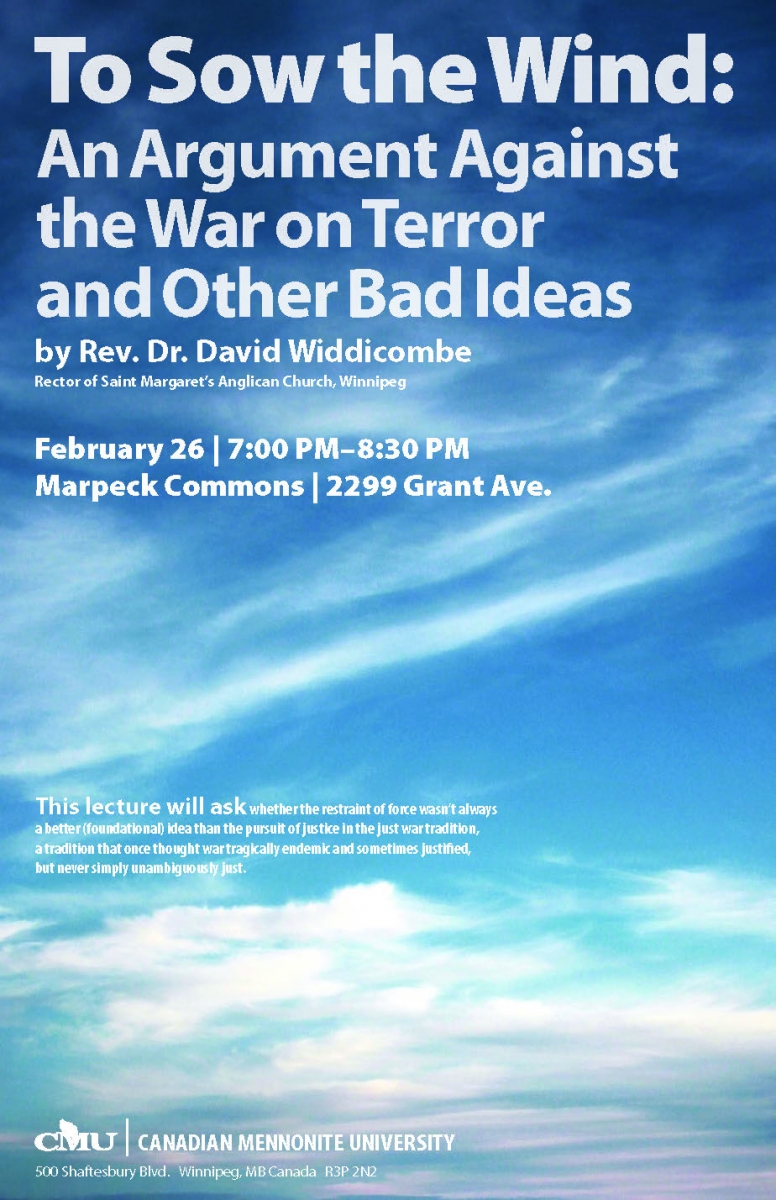
Just War theory has received a lot of attention in recent times but the results have been mixed. It is no longer a tradition of thought designed to place strict restraints upon the use of force in the necessary use of force in restraint of evil. Under the pressure of humanitarian interventionism, theories that democracies do not fight wars against each other, American (and Western) exceptionalism, supposed states of emergency, and other ideological adventures upon the turbulent seas of the international order, the tradition has lost its profound Augustinian political skepticism and moral realism. This lecture will ask whether the restraint of force wasn't always a better (foundational) idea than the pursuit of justice in the just war tradition, a tradition that once thought war tragically endemic and sometimes justified, but never simply unambiguously just.
Rev'd Dr. Widdicombe is the Rector of Saint Margaret's Anglican Church in Winnipeg.
Winter Lecture Series
The CMU Winter Lectures was an annual public lecture series that highlighted the arts, science, humanities, and interdisciplinary studies at CMU and to foster dialogue between these disciplines and the Christian faith. The series ran from to 2006 to 2011.
Audio/video recordings of these lectures are available through CommonWord Bookstore and Resource Centre.
2011: Resonance, Receptivity, and Radical Reformation
Lecturer: Dr. Romand Coles, McAllister Chair in Community, Culture, & Environment at Northern Arizona University. Resonance, Receptivity and Radical Reformation
2010: Paradoxes of Reconciliation
Lecturer: Vern Redekop, Associate Professor of Conflict Studies at Saint Paul University in Ottawa. Topic: Paradoxes of Reconciliation
2009: Placing Our Faith in a Placeless World?
Lecturer: Dr. Norman Wirzba, Research Professor of Theology, Ecology and Rural Life, Duke Divinity School. Topic: Placing Our Faith in a Placeless World?
2008: Art, Beauty, and Christian Theology
Lecturer: Erica Grimm Vance, Assistant Professor and Visual Arts Coordinator, Trinity Western University. Topic: Art, Beauty and Christian Theology.
2007: Cosmology, Evolution, and Resurrection Hope
Lecturer: Dr. Robert Russell, Professor of Theology and Science, Graduate Theological Union, and Director for the Center for Theology and the Natural Sciences. Topic: Cosmology, Evolution and Resurrection Hope.
2006: Psychology and Theology
Lecturer: Alvin Dueck, Evelyn and Frank Freed Professor of the Integration of Psychology and Theology, Fuller Theological Seminary
Proclaiming the Claims of Christ Lecture Series
This lecture series has been offered at CMU since 2007. The series addresses the various dimensions of Christian apologetics (theory, evangelism, Gospel and society, singularity of Christ in a multi-cultural context, etc.).
Previous Lectures
2012: The Unique Gift of Christ
Lecturer: Dr. Benne Jordan-Trexler Professor of Religion Emeritus and Director of the Center for Religion and Society at Roanoke College, Salem, Virginia.
2011: Cancelled
2010: Proclaiming the Unique Claims of Christ; Negotiating the Christian-Muslim Interface
Lecturer: Emmanuel Ali El-Shariff
2009: Being a Christian in the public media, radio broadcaster, and media commentator
Lecturer: Michael Coren
2008: Proclaiming Christ in a Post-Christian World
Lecturer: John Stackhouse, Regent College.
2007: Joe Boot, evangelist, apologist, author and the executive director of Ravi Zacharias Ministries in Canada.