


Stories
What does it mean to live with AI?

Before taking The AI Revolution course, Elizabeth Schellenberg thought artificial intelligence began and ended with ChatGPT.
"Before the course, I absolutely thought AI was ChatGPT, full stop," she says. "Now I'm realizing the broader implications and how it penetrates every area of our lives."
This past winter, Dr. Tim Rogalsky, Associate Professor of Mathematics at Canadian Mennonite University (CMU), taught a six-part course called The AI Revolution through the CMU Xplore extended education program. The course explored the uses and implications of artificial intelligence in everyday life.
"This is not a how-to-use-AI course," Rogalsky said, emphasizing that the goal was to better help participants understand what AI is and how it shapes the world around us.
The Xplore program at CMU offers courses designed for older individuals that examine the various dimensions of Christianity in the world today.
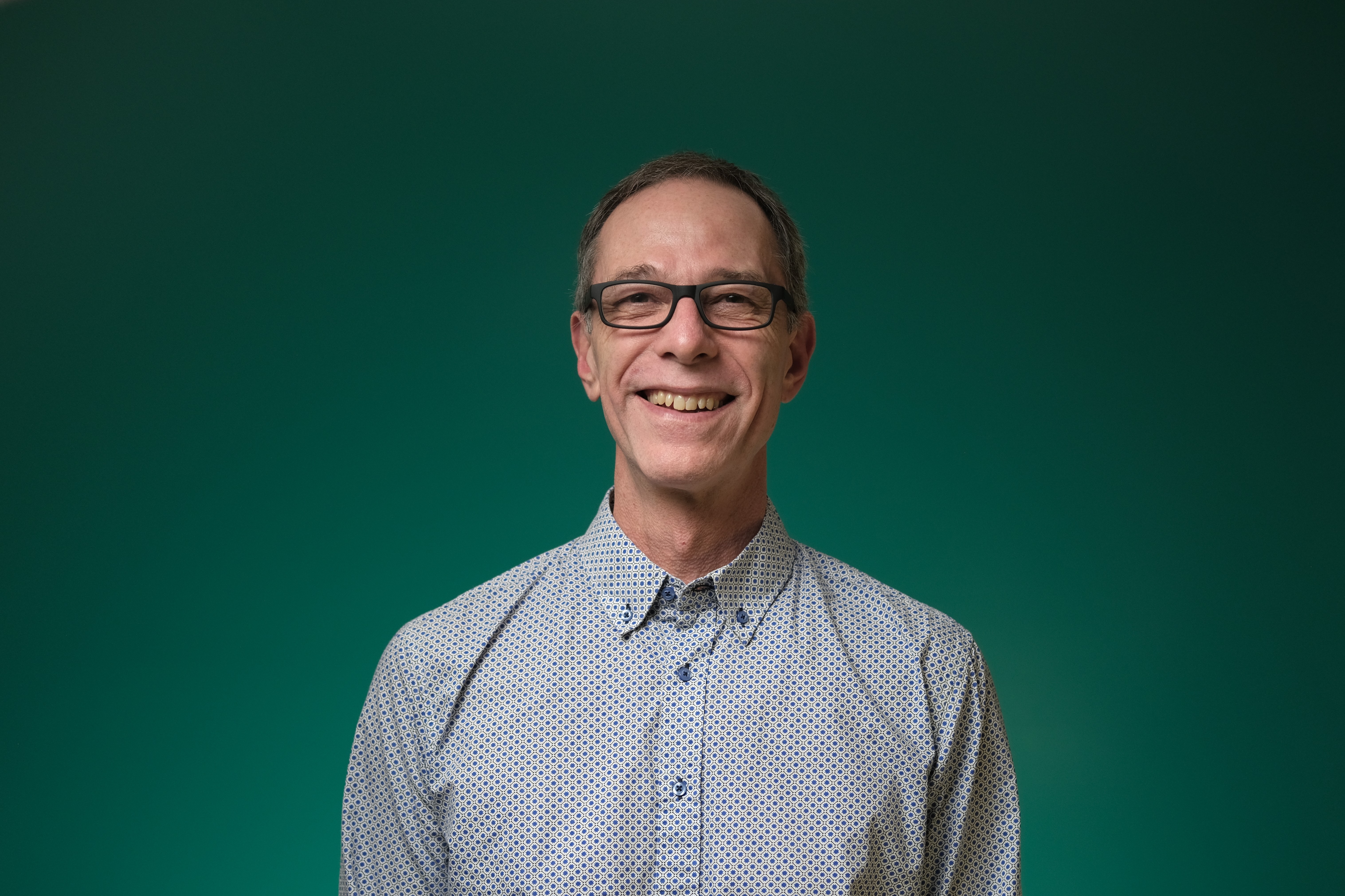
Dr. Tim Rogalsky, Associate Professor of Mathematics, leads discussions in the CMU Xplore course The AI Revolution, where participants explored how artificial intelligence shapes everyday life.
In Rogalsky's course, participants considered what AI is and what it isn't, how it works, and why so many people are either feverishly excited or uneasy about its emergence. Discussions moved beyond definitions to questions about AI's role in personal life, employment, and politics.
Throughout the course, Rogalsky emphasized what is often called the "alignment problem", the challenge of ensuring that advanced AI systems act as trustworthy partners. But rather than focusing only on risk, he argues for a cooperative approach to integrating AI into people's lives.
"What if we think of the world in terms of interconnection and flat instead of hierarchy; that we are in a relationship with all things?" Rogalsky says. "We need to live in reciprocity and friendship and relationship with all things."
Part of that relationship, he suggests, comes from reciprocity with the large language models. Rather than ignoring AI or using it uncritically, course participants were encouraged to think carefully about how and why they engage with it in everyday situations.
"AI learns and will either learn from those who are 'good people' or people who want to use it for nefarious purposes," says Joan Alty, a participant in the course. "So that made me think that perhaps there is a reason to do it."
That sense of responsibility was paired with a growing awareness of how embedded AI already is in daily routines. From navigation tools to online systems, participants reflected on how often they rely on AI without recognizing it.
"I think it's easy to bury our heads in the sand and say 'No, just don't use AI. It's all bad,'" another participant, Elizabeth Schellenberg says. "And I think it's much better to take a balanced perspective."
Participants were also encouraged to reflect on their own experiences with technology and how those experiences shape understanding. Rogalsky noted that we've been using artificial intelligence in various capacities for years now.
"AI is actually a massive umbrella that includes so many different things," he says. "Take a GPS system for example. When we take directions, when we give it, ask it to give us directions, we don't think of it as AI—it is."
The course concluded by reflecting on the potentially unavoidable onset of AI and what it means to live wisely alongside it.
As Rogalsky describes it, the goal of the course was not to resolve every question about AI, but to offer a clearer way of seeing it.
"We ended our last two classes thinking about AI safety," he said. "and thinking about how we respond personally in an age where AI is already almost everywhere."
Rogalsky hoped the class offered space to better understand a rapidly evolving technology through conversation rather than instruction. And for him, the course reflects something broader about CMU: a commitment to asking deeper questions about the world and our place in it.
He says CMU grows students who think about justice, equality, distribution of wealth and power, and what it means for society to flourish.
In this fast-shifting world, Rogalsky says. "We need people like CMU produces in order to help us think about what the future will look like."
 Print This Article