
This century has 25 years
A microhistory of Canadian Mennonite University
On an unseasonably warm fall evening, the annual J.J. Thiessen Lecture series at CMU was underway. The Scriptures had been read, and for the night of October 22, 2024 it came from Hebrews 12:1-2 where the Christian faithful are reminded of being surrounded throughout history by a "great cloud of witnesses" as an encouragement to put off all weights and sins to run the race set before them, focused on Christ.
The hymn too was sung; this time it was Frances R. Havergal's 1874, "Take My Life and Let it Be" of a life consecrated to Christ. The speaker was Bruce Hindmarsh, Professor of Spiritual Theology and the History of Christianity at Regent College in Vancouver, British Columbia.
His theme for the lectures was the spiritual theology of the early evangelicals of primarily the eighteenth-century north-Atlantic world. That evening he talked about the life-long process and challenge of the Christian life transformed. Though the lecture was wide-ranging, the brothers John and Charles Wesley loomed large.
As the Wesley brothers died in 1788 and 1791, Russian Empress Catherine the Great invited the Mennonites in Prussia to settle newly acquired land in the Empire, in present day Ukraine.
What followed was over a century of institutional and economic development combined with some religious renewal movements. In 1849, Peter Martin (P.M.) Friesen was born and 11years later emerged the Mennonite Brethren.
Friesen was many things; an educator, minister, philanthropist, defender of persecuted peoples, and an historian. Though he was part of the new movement, he hoped for Christian unity, especially among Mennonite groups. He remained a strong supporter of Mennonite traditions and teachings, combined with pietism.
Due to his command of Russian, Friesen was called upon at times to represent Mennonites before government officials where accounts say he was effective in communicating Mennonite civil and religious interests.
In 1887, he accepted the task of writing a history of the recently formed Mennonite Brethren. At the time the task was thought by some to take a fortnight. In the end he took a quarter century and produced a monumental volume that was both history and a collection of documents germane to the Mennonite Brethren.
Yet the book was more than a near thousand pages of Mennonite Brethen materials. He reached back to capture Mennonite migration to Russia and ended it with chapters on the Mennonite Brethren, General Conference Mennonites, and (Old Order) Mennonites in America.
His historical method pulled in many aspects of Mennonite life in Russia, where, in addition to religious faith and practices, he included business and education. As the CMU audience waited for the introductory matter to give way to the evening's lecture, CMU President Dr. Cheryl Pauls had a major announcement to make.
Thanks to the generosity of a Winnipeg Mennonite Brethren businessman, CMU was to have its first endowed chair. It made perfect sense that the new chair in Mennonite Brethren theology and biblical studies be named after P.M. Friesen, drawing from his legacy and vision of spiritual renewal, inter-Mennonite unity, and the importance of history and religion to understanding, in his time, Mennonite life in Russia.
The connective tissues of that evening, which joined past and present, included the physical space, or as Pauls called it, "locatedness." She expressed it through the land acknowledgment connecting CMU to a local geographical past measured in millennia whereas a spiritual locatedness was articulated through the outline of Friesen's book back to the 16th-century Reformation.
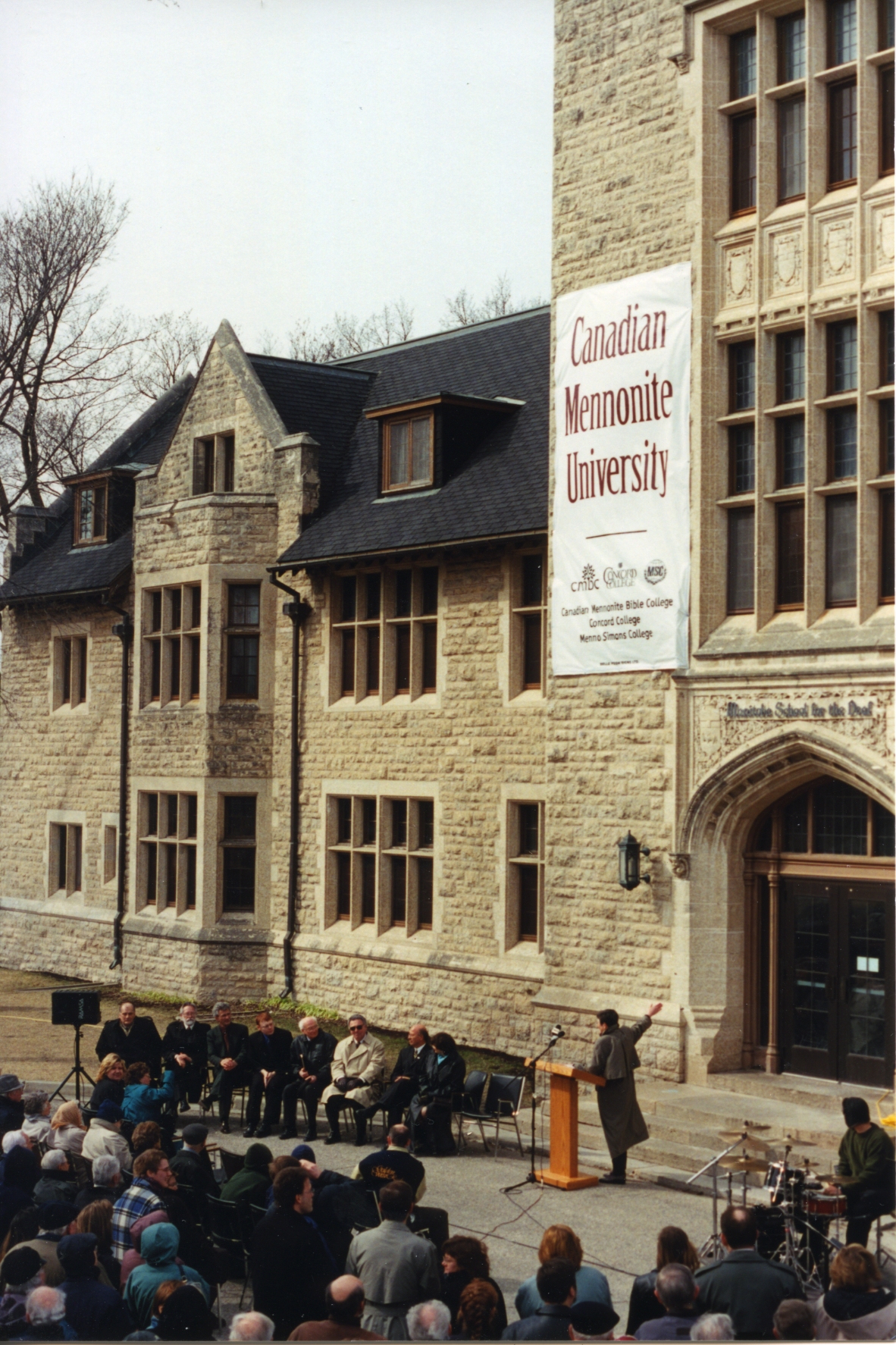
The buildings, too, contain lineage. On May 9, 1921 the cornerstone of the Manitoba School for the Deaf was laid and construction began on an impressive gothic style building, featuring Manitoba limestone, that saw its first students—from across the prairies—enter on September 22, 1922.
Meanwhile, that same fall in Russia, the Soviet government began its crackdown on religious instruction in schools. The harsh policy was very disappointing to the Mennonites, among whom was 29-year-old school teacher, Jacob Johann "J.J."Thiessen. Vexed by those developments, he became involved in Mennonite emigration plans to Canada and he and his wife Tina finally boarded a ship to Canada to arrive in November 1926.
The interwar years were filled with numerous challenges. At the end of the 1930s Great Depression, the Mennonite Brethren in Winnipeg began serious discussions about creating a school academically situated between the Bible schools that dotted the prairies and the public university.
In 1944 they opened the Mennonite Brethren Bible College (MBBC). At the same time, starting in 1941,the Conference of Mennonites in Canada held formal conversations about starting a Bible college (discussions had begun in the late 1930s) and in 1947 they opened the Canadian Mennonite Bible College (CMBC) in the basement of Bethel Mission Mennonite Church. J.J. Thiessen worked a number of years on the CMBC board and tirelessly sought solid presidents to give the fledgling college solid scholarly leadership. It had a few homes until 1956 when it moved into their newly constructed campus at 600 Shaftesbury Blvd.
Despite their differences, those two groups of Mennonites in Winnipeg sought ways to navigate modern life with theological, biblical, and academically astute thinking and Christian practice.
Meanwhile, across a pathway that became Grant Avenue in the early-1960s, the gothic structure saw the Manitoba School for the Deaf depart for the Wolseley neighborhood.
During the war, it was the Royal Canadian Air Force No.3Wireless School for the training of air gunners and ground signal operators. In 1945 the RCAF left the building and it became a Normal School for teacher training until 1953.From 1966-1996 the Manitoba School for the Deaf returned. In the interim the City of Winnipeg used the building for emergency housing for about 100 families and classroom space for the Winnipeg School Division. That building holds important stories of provincial and national educational projects and is now a registered provincial historical site—of which CMU is the guardian.
The CMBC site represents a longer presence of Mennonite education in the area, and the two sites were connected in 2014 by the Skywalk and Marpeck Commons, immediately becoming the hearth of CMU.
To honour Thiessen's role as a founder and longtime board member of CMBC, the lecture series was established in1978. The specific space for the J.J. Thiessen lectures in 2024was the CMU chapel that has overlooking it the large iconic painting of Jesus by Ray Dirks. In 1998, near the chapel, the MHC Gallery opened with Ray Dirks as founder and curator, a position he held for twenty-three years, guided by the art gallery's mandate to feature artists of any Mennonite/Anabaptist persuasion, and any artist of any spiritual tradition.
As the stage in October 2024 filled for the formal announcement, President Pauls led the proceedings. Her background was in music as both scholar and performer, and she began to teach in the CMU predecessor colleges in 1994, near the time that the first walk through of the "castle" building north of Grant was held to consider as a possible place for a Mennonite university.
Following Dr. Gerald Gerbrandt as CMU's first sole president, Pauls, in 2012, moved from the music wing to the President's Office where she has served and handled a range of changes and challenges in Canadian higher education, society, and the Mennonite world itself.
Pauls then announced the establishment of the P.M.Friesen Chair in Biblical and Theological Studies, introduced the donor, Edwin Redekopp, and the two co-chairs to initially hold the position, Dr. Andrew Dyck and Dr. Paul Doerksen.
Redekopp spoke of wanting to honour his parents through this chair and described his father Henry's life of faith and churchly involvement. Henry immigrated to Canada in 1924 and in1939 purchased the Roadside Store on Henderson Highway. It grew over the years into a building materials centre known eventually as Redekopp Lumber and Supply.
In 1957 Henry started Allmar Inc., as a wholesale distributor to lumberyards and the construction industry. He described his father as deeply involved in the church, both Mennonite and beyond. Business was not only an economic activity, but a platform for Henry to share his faith with others.
Over his lifetime Henry served with the Gideon's, Mennonite Brethren Mission Board, the Christian Business Men of Canada, was for sixteen years Area Captain of the Salvation Army, President of the downtown YMCA, supporter of the Mennonite Brethren Biblical Seminary in Fresno, California, and was a supporter of the English translation of P.M.Friesen's book, The Mennonite Brotherhood in Russia (1789-1910). In Mennonite higher education in Winnipeg, Henry served as chair of the MBBC board and was a founding board member of Menno Simons College (MSC), two of the three predecessor colleges of CMU.
The two newly minted co-chairs gave their thanks. Dyck, a professor working in Christian spirituality and pastoral ministry, noted the formational shaping of people in the university's mission.
Doerksen, a professor in Anabaptist theology and literature, concluded the launch by citing the word "irenic" in relation to Friesen's approach to theological disagreement, a quality he hope to embody in his work in this new position.
With Mennonite business history represented by the donor Edwin Redekop, that connection to Winnipeg's history continues—with David Friesen who, with his wife Katherine Loewen, started Quality Construction Company (later Qualico Developments Canada). David Friesen was a major benefactor and founding chair of the Menno Simons College board.
MSC was born from a dream in the 1970s when Friends of Higher Education was formed to pursue the creation of a Mennonite college attached to a public university outside of church denominations. That dream was realized in June 1982 when the provincial government granted MSC a degree-granting charter.
When MSC opened, it led with an emphasis on conflict resolution and international development in a context of Mennonite-based agencies grounded in the Anabaptist peace tradition. MSC realized its formal relationship with the University of Winnipeg in 1988, offering university credit courses in 1989. Business has long been connected in Mennonite higher education, from the content of P.M. Friesen's book to the endowment of the chair, to the 2011 creation of the Redekop School of Business by another Redekop family from British Columbia.
To get to 2024, though, CMU first had to get through 2000 and its first class as a stand-alone liberal arts university. That reality was long in some peoples' dreams. The first conversation of a unified institute of higher education across Mennonite Brethren and Conference of Mennonites lines was already held in 1944. It took until the 1990s for circumstances to align, making a Mennonite university from the existing colleges a reality.
For that, it came to industrialist, philanthropist, and refugee advocate Art DeFehr to ta kea leading role in getting the potential university economically grounded for its early years. DeFehr also worked to gather the political support from the provincial government where the willing Conservative government of Gary Filmon helped CMU reach the starting line. The process also took the work of many men and women to make the case for what became CMU.
There, that evening, on the CMU campus many historical ligaments that connect to form the university were present. From the people seated and speaking, the founding denominations represented, the predecessor colleges, the namesakes of the lecture series and the new chair, the background of the donor, support from business, effective representation to government, the physical space, references to a range of academic disciplines—history, theology, biblical studies, spiritual theology, pastoral ministry, art, and music—to the binding threads of faith, learning, scholarship, irenic relationships, and Christ, major portions of CMU's history were present.
Of course, not nearly all aspects of CMU can be discerned from the microhistory of one evening. For that we await the writing of the first comprehensive and scholarly history of CMU.
Though, to understand October 22, 2024, we must first go back a century to a time that was very precarious for not only a stream of Mennonites seeking safety from Soviet Communism but was soon precarious for the world. In that time of stress, dislocation, war, and global instability, the Mennonites in Winnipeg set about starting Bible colleges.