
A different approach to preparing future teachers
 The inaugural Bachelor of Education cohort at CMU is learning to create classrooms where every student feels valued, supported, and included.
Two months into Canadian Mennonite University's (CMU) inaugural Bachelor of Education After-Degree Program, future teachers are already putting their learning into practice. Through classroom discussions, school placements, and Indigenous land-based education, students are exploring an approach to teaching that places belonging and relationships at the centre of learning.
For Dr. Christine Kampen Robinson, who led the program's development, that approach begins with recognizing the value of every student.
"Our task as educators is to create opportunities for learning where every kid knows they matter, every kid has a voice, every kid's identity is recognized and valued—their culture, their languages, their backgrounds—and where school can become a place where they can learn and grow without fear of making mistakes," says Kampen Robinson.
Kampen Robinson is Co-Chair of Education, Assistant Professor of Education and Social Sciences, and Director of the Ens Centre for Career and Vocation.
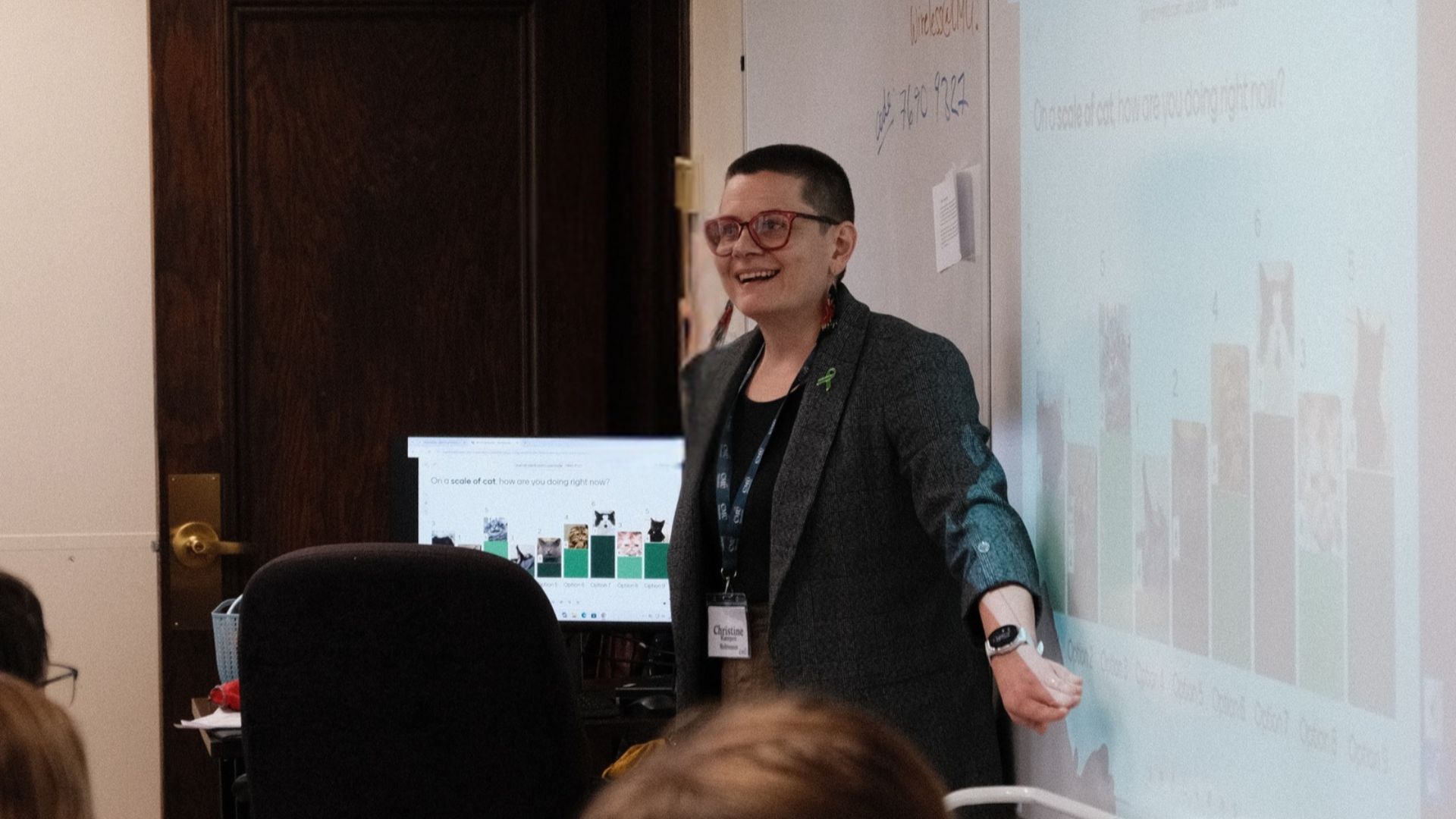
Dr. Christine Kampen Robinson, Co-Chair of Education at CMU, helped develop the university's Bachelor of Education After-Degree Program with a focus on belonging, relationships, and inclusive learning.
In developing the program, she drew on the Manitoba Framework for Learning and its orientation to Mino-Pimatisiwin (The Good Life), along with conversations with the provincial government, CMU alumni working as educators, and an Indigenous council.
Those conversations helped shape a program built around a central principle: belonging.
The provincial government identified a need for greater diversity among Manitoba's teachers, including Black, Indigenous, and neurodivergent educators, "so that there is more representation among teachers that aligns with the children that are actually in schools in Manitoba," Kampen Robinson says.
For CMU, this meant considering how future teachers could create classrooms where students with different backgrounds, identities, and learning needs feel valued and supported.
"I really think there was intentionality in the design, thinking about creating the next generation of teachers to teach beyond the curriculum," says Michelle Yaciuk, Co-Chair of Education and Associate Professor of Education and Music Therapy.
Yaciuk joined the initiative after the education program proposal was approved, helping bring the program to life through student interviews, faculty recruitment, and partnerships with schools for teaching placements.
"Curriculum is important, but... the classroom doesn't start and stop with academics, and the student, as a person, doesn't start and stop when the bell rings," she says.
This philosophy reflects the longstanding commitments of CMU to hospitality, community, peace, and justice. Small class sizes, interdisciplinary learning, and meaningful relationships between students and professors provide a foundation for preparing teachers who understand education as more than the delivery of curriculum.
That commitment is reflected in how the program begins.
CMU partnered with the teaching team at Sandy-Saulteaux Spiritual Centre, an Indigenous-led learning centre dedicated to Indigenous theological education and spiritual formation. Building on an established relationship between the institutions, the team introduced students to land-based learning on the CMU campus before welcoming the entire education cohort to its centre near Beausejour, Manitoba, for five additional days of Indigenous education.
"There's a reason we kicked off the whole degree with Indigenous education," says Yaciuk. "It wasn't to get it out of the way, it was to set the foundation of how the students are thinking and what they're doing every step of the way."
The Sandy-Saulteaux teaching team developed the learning experience, including its format and assignments, rather than following a structure prescribed by CMU.
For Kampen Robinson, this approach reflects the importance of learning from Indigenous ways of knowing and teaching.
"Indigenous pedagogies are, by design, experiential and holistic. Ever since I started learning about Indigenous pedagogy a decade ago, I thought, 'This is what education is about!'"
The same emphasis on experiential learning carries through other aspects of the program.
Teaching placements are designed to align more closely with the K–12 school system, while deadlines for theoretical assignments follow practical classroom experience. A co-teaching model also positions student teachers and mentor teachers as collaborators from the beginning of their placements.
These decisions reflect feedback from teachers, students, and alumni, and are intended to strengthen the connection between educational theory and classroom practice.
"We always need to ask the question: What is the purpose of this in my life as a future educator?" Kampen Robinson says.
The inaugural cohort brings a wide range of professional and life experiences to the program, including backgrounds as educational assistants, librarians, social workers, and coaches.
Yaciuk says faculty and co-teachers have been enthusiastic about the students and the perspectives they bring.
"It's a really impressive group of humans who are so thoughtful and already dedicated to the field of teaching."
As these future educators begin their journey, the goal of CMU is to prepare teachers who recognize that meaningful learning begins with relationships—and that every student deserves to know they belong.