
A CMU student's research journey reaches Zimbabwe
Part of the CMU Research Month series
 CMU graduate Asher Warkentin travelled to Zimbabwe to study the ecological effects of climate change on river ecosystems.
As Canadian Mennonite University marks its first Research Month this May, stories like Asher Warkentin's show how student research can extend far beyond the classroom, from Manitoba to wetlands in southern Africa.
To Asher Warkentin, studying at CMU means travelling to southern Africa to look at microscopic invertebrates.
Warkentin recently returned from Zimbabwe, where he joined researchers connected to the Locally Led Indigenous Nature-Based Solutions for Climate Change Adaptation in Zimbabwe (LINCZ) project, a Global Affairs Canada-funded initiative focused on climate resilience and biodiversity in partnership with MCC.
The LINCZ project is a four-year initiative focused on enhancing the resilience of 15,000 households across Zimbabwe by implementing nature-based solutions to adapt to climate change, restore biodiversity, and improve local livelihoods.
By collaborating with local communities, this project ensures that conservation efforts effectively address environmental degradation while securing sustainable food sources for the region's most vulnerable.
For three weeks, Warkentin accompanied Rachel Krause, Associate Professor of Biology at CMU, studying the ecological effects of nature-based solutions on invertebrates in waterways in various parts of the country.
Warkentin's journey into this $15 million Global Affairs Canada-funded initiative began in his third year when he applied for a research assistant position. This role evolved into two semesters of independent study.
During this time, Asher conducted fieldwork with Postdoctoral Researcher Natalia Wiederkehr, who is also a CMU sessional instructor, on Geographic Information Systems (GIS), analyzing land-use changes across the Mwenezi, Binga, and Gwanda districts.
By comparing satellite images over several years, they tracked land-use changes due to environmental shifts.
The heart of the trip centered on the LINCZ project's focus on nature-based solutions. The team travelled to wetlands in three distinct districts where invertebrates serve as vital biological indicators of river health.
"If you find a lot of dragonflies, that might say that the river has more disturbances happening to it than if you find, for example, mayflies," Warkentin says.
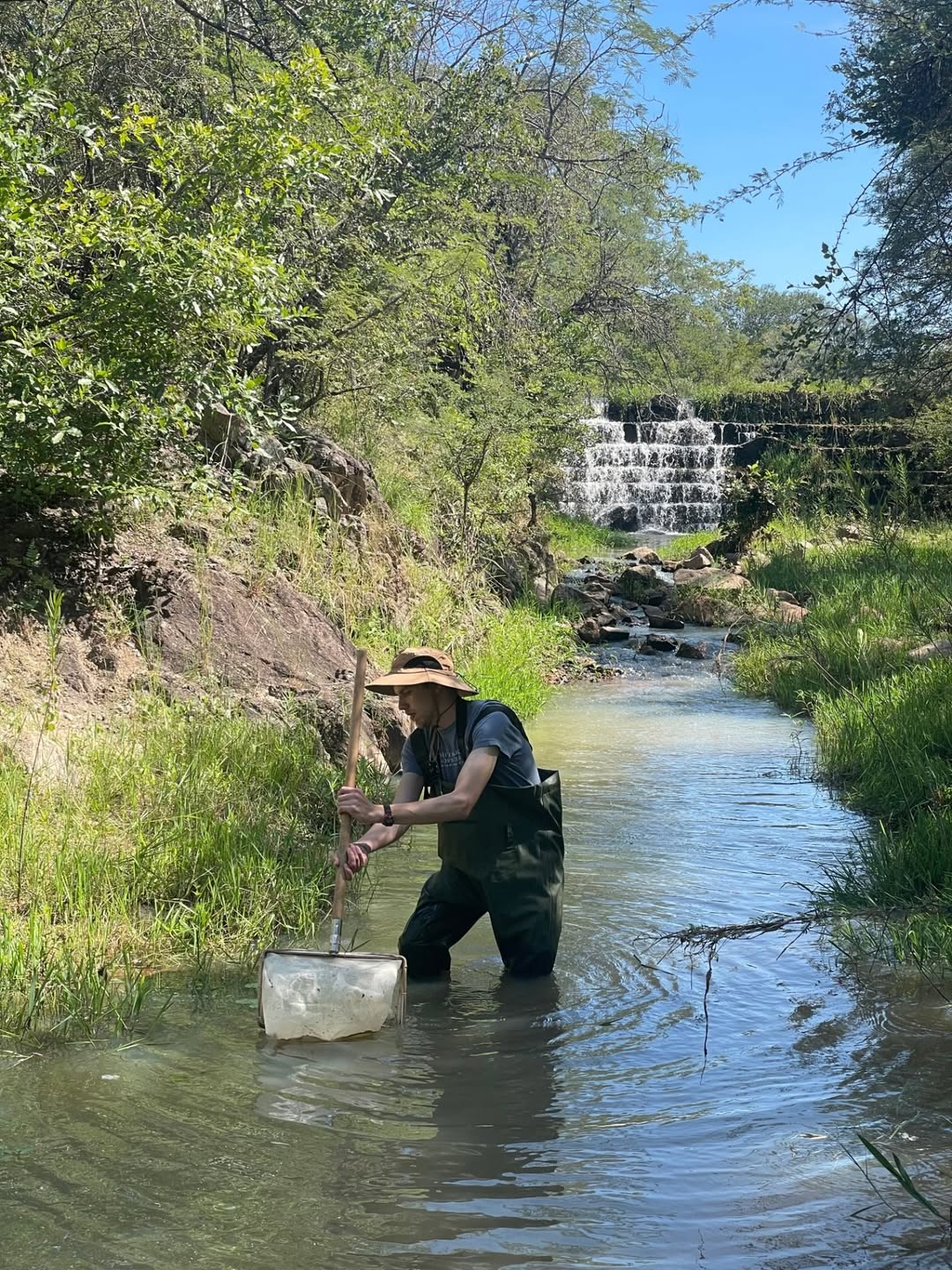
Warkentin collects aquatic invertebrate samples during field research in Zimbabwe connected to the LINCZ climate resilience initiative.
Using the Southern African Scoring System (SASS5) protocol, the team collected data for the rivers' health, which is helping to determine if the LINCZ project's conservation efforts are improving the water quality.
Although science was the reason for the trip, perhaps the most informative revelation was human-focused relationships.
Warkentin says the collaborating biology professors, Luke Jimu and Admore Mureva from Global Biodiversity Information Facility and Bindura University of Science Education "were prioritizing those relationships with the local farmers... They'd spend half of the time chatting and just making sure that the relationship was good, and then they would collect what they needed."
Warkentin says this collaborative approach is central to the LINCZ project, combining scientific tools like GIS mapping with Indigenous knowledge to address local environmental challenges.
He was also struck by the ingenuity of the local farmers, who he saw using various nature-based solutions, from intercropping beans to the use of biogas digesters that convert cattle manure into cooking fuel.
The flexible environment at CMU, he says, enabled him to balance a three-week international research trip with his other coursework.
"I feel like it was really a good example of what CMU can offer," he says. "You'd never have this sort of experience at a larger university."
Warkentin graduated from CMU this past spring, looking forward to taking a year break, bird banding for a consultancy agency in northern Alberta, before pursuing graduate studies where he hopes to transition his ecological focus away from water-dwelling microbes toward his primary passion: birds.