
Verna Wiebe | 2025 Kay and Lorne Dick Teaching Excellence Award recipient (video)

Verna Wiebe, Teaching Assistant Professor of Music, worked at CMU and its predecessor college CMBC for 37 years, starting in 1988 and retiring in 2025. She and Dr. Paul Doerksen, Associate Professor of Theology and Anabaptist Studies and P.M. Friesen Co-Chair in Biblical and Theological Studies, are co-recipients of the 2025 Kay and Lorne Dick Teaching Excellence Award.
The award, established in 2022, is granted annually to two faculty members who best exemplify CMU's commitment to excellent teaching.
How would you describe your teaching philosophy? How has it evolved over the years?
Over the years my teaching philosophy has evolved in nuance, but its core has always remained consistent: always student-centered and an emphasis on a strong foundation. Whether working one-on-one or with my classes, I would begin where students actually are. I held high expectations always, but those expectations were appropriate to their starting point. Strong fundamentals mattered to me, so we built carefully and sequentially rhythm, coordination, listening, technique, because confidence grows from that solid foundation. Students were grouped according to skill level when it was helpful and the instruction shifted then to meet varied needs. Growth did not look the same for everyone, but progress was certainly expected by all. One of CMU's pillars is "learning through thinking and doing." In my classroom, that thinking was immediately physical: hands on the keyboard, feet marking rhythm, bodies engaged in the act of music making. The doing was the thinking; understanding was not abstract, it was embodied.
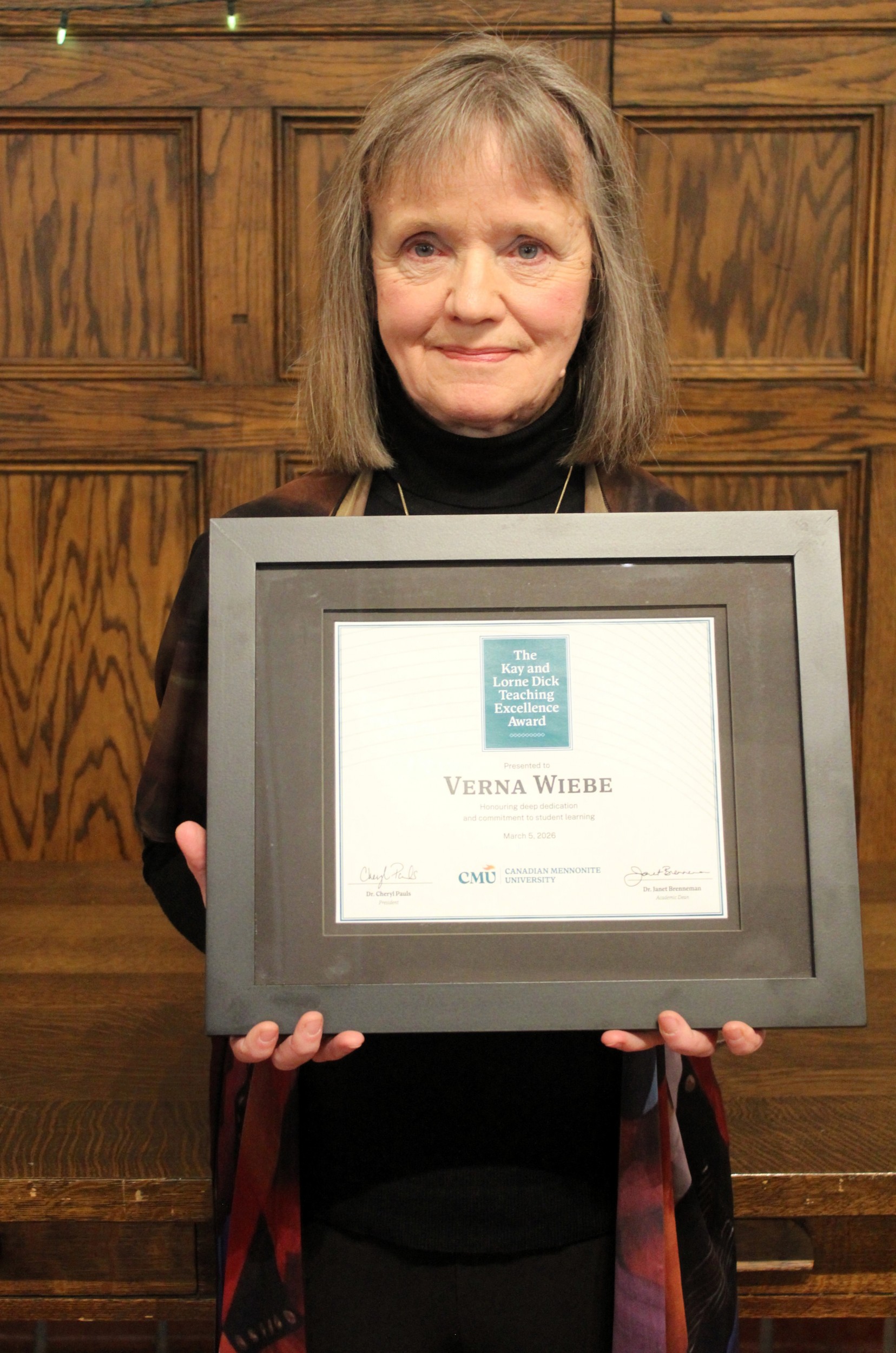 Verna Wiebe: "One of CMU's pillars is 'learning through thinking and doing.' In my classroom, that thinking was immediately physical: hands on the keyboard, feet marking rhythm, bodies engaged in the act of music making. The doing was the thinking; understanding was not abstract, it was embodied."
What strategies do you use to engage and inspire your students?
I would model skills as needed, whether demonstrating a collaborative passage at the piano or unpacking a difficult keyboard concept. I wanted students to hear and see what was possible, not to impress them but to show them the goal was within reach. Often after modeling is where there were these "aha" moments: "I get it!" When students can experience small, concrete progress, motivation follows—and that's so important in music making and at the keyboard.
How do you balance academic rigour with making learning enjoyable for your students?
I have always believed that rigour is a form of respect. Music requires repetition, patience, and discipline. I do not lower the expectations, but I try to frame them positively. At the same time, joy sustains the effort—when a rhythm finally locks in, when collaborators breathe together naturally, when a handbell ensemble achieves clarity of sound, those moments are joyful. Students often laugh when something falls apart, and then they try again. Serious work and joyful work are not opposites; in music education, they belong together.
What impact do you hope to leave on your students?
I hope the impact goes beyond the skills learned in class. Of course, I want students to have learned to read well, coordinate confidently, listen carefully. But more than that, I hope they carry persistence, attentiveness, and collaborative sensitivity into their work. Since retiring, I've heard from a number of music alumni, particularly those now working as music therapists or music teachers, who have shared how foundational these skills have been in their careers; hearing that has been deeply meaningful. Perhaps what has meant just as much to me, though, is when they have expressed gratitude for being pushed, for being challenged, and for not being allowed to settle. It reminds me that learning continues long after the classroom ends, and that is perhaps the greatest reward of all.
Is there a specific moment in your teaching career that stands out as especially rewarding?
I had a group of eight guitar students with limited piano experience in my Keyboard Skills class. Coordinating two hands at the keyboard did not come easily; it required a great deal of patience, repetition, and determination. One afternoon I found them outside at a picnic table under CMU's towering elm trees, stomping, clapping, and chanting rhythms—and laughing. They were having a great time and building community, and over the weeks the numbers grew. They weren't just completing an assignment; they were embodying the learning. That moment has stayed with me because it captured what teaching at its best can be: persistence, community, and students choosing to engage fully in the work. Certainly, another highlight is the handbell ensemble. I introduced the bells in my music skills classes as a way to review theory. Out of that was the call from some students to form an ensemble. The learning curve can be very steep, yet week by week, disciplined attention transforms uncertainty into confidence. The ensemble only succeeds when everyone succeeds, and to see how students over time have risen to the challenge has certainly been exciting. One of the most rewarding things has even been beyond the music making; they took it upon themselves to organize their own sectionals, worked hard between rehearsals, and became quite a community where they supported each other through difficult life situations and continue to be in touch with each other.
Previous recipients of the Kay and Lorne Dick Teaching Excellence Award:
2024
- Lynda Loewen, Teaching Assistant Professor of Psychology
- Dr. John Brubacher, Associate Professor of Biology
2023
- Dr. Jodi Dueck-Read, Associate Professor of Conflict Resolution Studies and Peace and Conflict Transformation Studies
- Dr. Candice Viddal, Associate Professor of Chemistry and Physics
2022
- David Balzer, Associate Professor of Communications and Media
- Karen Ridd, Teaching Associate Professor of Peace and Conflict Transformation Studies and of Conflict Resolution Studies